| Fri, 25 Sep 2020
Goodbye cruel world!In the rather unlikely event that anyone is reading this, then this is the last post. I have decided to restart my blogging at Wordpress. I have also decided to split my cricket blogging to another Wordpress blog, and technical blogging out to dev.to. And for the duration of the Pestilence Of 2020 I am keeping yet another Wordpress blog. | ||||||||||||||||||||||||||||||||||||
| Fri, 8 Nov 2019
Rugby World Cup roundup
| ||||||||||||||||||||||||||||||||||||
| Mon, 9 Nov 2015
Rugby World Cup roundup
My gripe from the last couple of years about scrums not being fed straight is at last being addressed a little bit by World Rugby. Feeds were a lot straighter in this tournament than they have been over the past many years, and a few of the most blatant skew-whiff feeds were penalised. The recent rule changes about setting up the scrum appear to have addressed the problem of scrum collapses at least a bit, but more work is still needed. I have a new gripe though - I think that referees are playing Advantage for too long. They are currently playing it after an infringement until a team gets a significant advantage. It should be scaled back. In rugby league, advantage doesn't last anything like as long, and the game is better for it. I propose that penalty advantage should finish when the team with advantage has carried the ball forward past the point at which the penalty would be awarded, even if only momentarily, or has kicked the ball forward no matter what the result of the kick. Knock-on advantage should end when the second player has possession or the ball is kicked. I realise that this makes advantage worth a lot less. As a result teams might be tempted to just stop playing so that there is no advantage. Therefore I also propose that not trying to take advantage should itself attract a penalty. It also makes penalties worth less, as you are less likely to get "two bites at the cherry". I'm fine with that. And it makes the punishment for technical infringements less onerous, which I'm also OK withI prefer a game with lots of running, driving mauls and so on leading to tries, as opposed to a series of penalty goals arising from pedantic nit-picking. Again, rugby league gets this right. I also have a minor gripe about the amount of time taken up by kickers doing ridiculous dances. They have a minute to take the kick, and the few stupid dances that I timed averaged just over 40 seconds. I propose cutting the allowed time from when the ball is placed on the kicking tee to when boot strikes ball to 15 seconds. | ||||||||||||||||||||||||||||||||||||
| Wed, 18 Mar 2015
Cricket World Cup 2015 awardsIt is, of course, still not Real Cricket, but I've enjoyed this world cup so far. And I'm even enjoying it after England were knocked out and proved that ICC stands for Inter-Colonial Cup. I have a couple of awards to give out.
I would have given Best Facial Hair to John Mooney of Ireland, but while he has more than Kohli, it's scruffy and looks like he just couldn't be arsed to shave. Kohli's may be a micro-beard, but it is at least deliberate. If Mooney wishes to be considered for this prestigious award in future he needs to man up and look like a tramp for a few weeks until his beard matures into a prodigious hedge, instead of just looking like a scruffy student. | ||||||||||||||||||||||||||||||||||||
| Sat, 29 Jun 2013
The Most Important Word in PublishingDustin Kurtz works for a publisher, and writes on their blog. His thesis is that authors do themselves a dis-service if they link to Amazon, and that they should instead link to some random small independent bookshop if they want to visitors to their websites to buy their wares. In this piece, he omits the single most important word in the whole of the publishing industry. That word is "readers". He does mention customers twice, but only in the context of making sure that a bookshop is willing to post stuff to them and when he says "even if not a single customer finds them through you, [the bookshop] will be happy" - which is wrong. A bookshop to whom you direct no custom at all won't be happy. They won't be sad either, they just plain won't care, or even notice. Well, I suppose they might be pissed off if they made a special effort to stock your wares when you told them you'd be linking to them, and then didn't sell any. At no point does he consider even for a moment what readers, the people who are ultimately paying his salary, want. Actually, the whole piece is confused. For example, he says that most people will go straight to Amazon in the first place and not visit author websites at all (which is probably true) but then thinks that that is a good reason for authors to not link to Amazon. Errm? The links to Amazon are for people who have visited the author's website and have not gone straight to Amazon. What people do who go straight to Amazon is irrelevant. Once someone has come to your website, they are, provided your site doesn't suck, yours, and they will keep coming back. Just like I keep going back to Charlie Stross and Hugh Howey's websites, via their RSS feeds. But anyway, back to readers. What readers want is a combination of convenience and reliability. Amazon does both of those brilliantly, and with excellent customer service for the very few times that they screw up. So, authors - please don't link to small local bookshops. It's far less convenient for your readers, who end up with a bazillion separate accounts with a bazillion separate online shops, and have to type all their details in a bazillion times, often fighting against idiotic web forms that simply won't accept their address* or phone number** or email address*** or whatever. Once the reader has fought through all that, he has to hope that your order fulfillment process works, that you know how to get stuff reliably to his door, and that if anything goes wrong you have heard of customer service. Nah. Far better to just use Amazon. In addition, I hear anecdotally that some authors make more money in Amazon Affiliates kickbacks than they do in royalties. If you don't link to 'em, I'll go there myself anyway if I want to buy your stuff. * too many insist that all addresses have a state or a county, or don't have enough lines ** many won't accept phone numbers from other countries *** many won't accept addresses with a + sign in them | ||||||||||||||||||||||||||||||||||||
| Wed, 12 Jun 2013
The Nicaragua Canal
" Many have been asking whether Central America needs two canals, even in an age of growing world trade. " No-one who cared about free trade would ask that. Competition is Good. While there are other routes between the Atlantic and the Pacific, they are either very long (around south America) or not reliably open (Northwest Passage). The Panama canal is also not big enough for many modern ships, and still won't be even after the current upgrades are complete (see image to right). Broadly speaking, the larger your ship the cheaper it is to run per ton-mile of cargo, and it's less polluting too. And, of course, shorter routes between the same two ports are also cheaper. | ||||||||||||||||||||||||||||||||||||
| Sat, 4 May 2013
Amazon efficiency, part 2I recently ordered a Huawei 3G-to-wifi router thingy from Amazon. It's crap and doesn't work so, after ordering a replacement made by another manufacturer, I had to return the duff one. Amazon make this really easy. All I had to do was fill in a form on their website, print out an address label with a barcode, stick that on an envelope, and take it to a Collect Plus franchise. There are bazillions of these, even in ruralistan. This is far more convenient than having to take something to a post office which is only open for a couple of hours a day because they want to go out of business. And best of all, the newsagent I took it to could scan that barcode, and my refund arrived within the few minutes it took me to walk back home. The mark of a business that knows about customer service is what they do when something goes wrong. When everything goes right it's easy to please your customer, but when it goes wrong, such as when you've sold something that doesn't work, it's much harder. By making returns so very quick, easy, and quibble-free, Amazon have done it. Bravo! | ||||||||||||||||||||||||||||||||||||
| Mon, 18 Mar 2013
Six Nations Roundup 2013Not a bad tournament this year, the stand-out game being the low-scoring match between Scotland and Ireland, and my man of the tournament was Ireland's Paddy Jackson. As usual I'll bitch about scrums. Not a single scrum was fed straight, and despite the recent rule changes there were too many resets and infringements leading to free kicks and penalties. The IRB must instruct referees to apply the damned laws: to punish crooked feeds at the scrum. And if they can't come up with a formulation of the laws that will permit putting pressure on before the ball is fed without the possibility of moving the scrum, then they need to change the laws so that when the scrum is set it is without pressure. I'd hate to see scrummaging disappear from the game, as it has in the League game, but I fear for it if the IRB and referees don't get a grip. Finally, a worrying development is players arguing with officials and trying to tell them what to do. This is supposed to be a gentleman's game, not Association football, and that behaviour Will Not Do. I'd like such dissent to result in a free kick or a penalty (as the laws already provide for), but realise that there are often players from both sides arguing. So I propose five minutes in the sin bin. | ||||||||||||||||||||||||||||||||||||
| Fri, 5 Oct 2012
Electric cars: the green threatFinally, the media are realising that electric cars are not such a good idea. I find the hoops they jump through with lifetime mileage assumptions interesting. They assume that electric and petrol/diesel cars have the same lifetime mileage, and then run the sums for different assumptions. Even with that bogus assumption, they struggle to show that electric cars are cleaner than normal ones. They can show that they emit less CO2, but that ain't the same as being clean. You also have to account for, as an example, the polluted run-off from the mines where the rare minerals that go into the batteries come from, and the waste products from processing those minerals into batteries. I read some research a coupla years ago which took into account that hybrids' batteries (and I presume that this applies to all-electric cars too) give an expected lifetime mileage of only 100,000 miles, whereas yer typical diesel pickup has an expected lifetime mileage of 250,000. While the pickup may have a higher environmental cost over its entire lifetime, the environmental cost *per mile* was lower because manufacturing the hybrid took so much energy, produced so much nasty pollution, and involved the sacrifice of baby elephants and seals with ritual incantations to the Elder Gods. But it's all a bit suspect, because none of this appears to take into account where they are driven and how they are driven. Not only are different vehicles and powerplants more suitable to different types of driving (eg motorways, low speed country roads, stop/start city traffic, carrying a heavy load, ...), they quite probably attract different kinds of people with different driving styles. You'd generally buy a Prius (for example) because you care passionately about polar bears, but you'd buy a normal car because you care more about making the best use of your time and money. In summary, if you care about the environment, you should avoid electric cars, avoid hybrid cars (unless you live in a big city and expect to do most of your driving there; hybrid wins in stop/start and slow traffic), buy a small efficient diesel. There are useful data here and here. | ||||||||||||||||||||||||||||||||||||
| Sat, 8 Sep 2012
Kiva microfinanceI'm a loan shark. Through Kiva, I've been lending money every month for the past few months to people in the third world so that they can invest in their businesses or education. I feel that it's a far better way of being charitable than just giving money. When you give money, it often gets used and then ... it's gone. And even when it does go to something useful in the long term, there's still a lot of waste. When you make a loan to help someone start or expand a business, they have something tangible at the end of it, and will be less reliant on charity and loans in the future. They can employ people too, and build up a reserve themselves to get them through lean times. And finally, when they pay back the loan, that money can go straight into making another loan, helping another person. Making small loans for well-defined capital projects where the borrower gets something tangible at the end of it is just so much more efficient than giving to charity, and it's very affordable. By putting lenders together into ad-hoc syndicates, very small amounts of money from many lenders come together to make substantial loans. So far, I've lent to a Palestinian who wanted to buy mics and sound mixing equipment for his radio station; to a Colombian to buy tools and equipment to set up his own metal-working business; to a Kenyan so she could buy seed to expand her farm; and to a Tajikistani student to pay for university fees. There are, however, lots of people looking for loans on the site who don't meet my criteria, and who won't gain from taking a loan. Take this example. She wants to borrow money to buy stock for her shop, which she will promptly sell, and then be left with a debt to be paid off over 14 months. She might make a very small profit, but once she's sold it all she'll need another loan to buy more stock, and so on, a never-ending cycle of debt and interest payments. No ma'am, not gonna "help" you with that. This is even worse. He wants a loan to pay off a loan and to buy food. This chap seems to have taken on debts that he couldn't pay off in the first place, so how can we trust him to be able to pay off the loan he's asking for? And borrowing money for food? That's just about the worst thing you can buy on credit, as you will have absolutely nothing to show at the end of it. I really recommend Kiva - or one of the other microfinance sites. They do good work, and I don't think that any other form of philanthropy comes even close to achieving their benefit to hassle ratio. Just be careful not to invest in dependency. | ||||||||||||||||||||||||||||||||||||
| Sun, 2 Sep 2012
Kindle in IndiaElectronic books have been around for ages - I was paying for them back in 1999 and classics have been available electronically for at least 40 years, thanks to Project Gutenberg. But it's only recently that they've become a mass market, and this is largely down to Amazon's Kindle. Oh sure, there are lots of other "e-readers", but the Kindle is the market leader. The last couple of years have, not coincidentally, seen an explosion of independent authors. Now that you don't need to print books, many authors who don't already have publication contracts are cutting out that particular middleman and self-publishing, using Amazon for distribution. The Kindle and Amazon ecosystem does, of course, have drawbacks. But by getting e-books out into the mainstream, something that normal people read and not just weird geeks, Amazon have enabled other sources of e-books to exist. Remember how cider used to be marginalised until Magners came along with their bloody awful pap and their enormous advertising budget? They made cider mainstream, and created a market for smaller producers of better-quality products. Amazon's mainstreaming of e-books has enabled sites like Smashwords to also take off. Most indie authors who self-publish on the Kindle also use sites like Smashwords to sell to users of non-Kindle devices. And now, the Kindle has launched in India. India is, as well as being the world's greatest democracy, the largest English-speaking country. I'm confident that the Kindle in India will precipitate a boom in electronic self-publishing there just as it has in the US and UK. And, of course, they'll want to sell world wide and won't have any idiot publishers to stop them. I'm looking forward to it! | ||||||||||||||||||||||||||||||||||||
| Fri, 25 May 2012
HMRC owes me money!Apparently some classes of creditor are treated differently from others when a football club goes bust, in unique and special footbally ways, and HMRC don't like that. They argued before a judge that "the most fundamental principle of insolvency law is that creditors share equally in a loss". That's odd, because 11 years ago this month when my employer went bust, HMRC were the first creditor to get paid, followed by (if anything was left) other businesses, with employees last. Naturally, I didn't get a penny of the £5000 that I'm owed - that's the month's salary in lieu of notice of the end of my employment, as laid out in my contract, plus two weeks salary not paid for time that I worked, plus a week's paid holiday I was entitled to. It seems that HMRC now think that's terribly unfair. I guess I need to send them an invoice. There were about 20 employees, plus maybe 10 corporate creditors, plus HMRC, so I estimate that I'm entitled to one part in thirty one of the company's assets, up to a maximum of £5000. Of course, HMRC have had my share of that for 11 years, so I need to also charge them interest. | ||||||||||||||||||||||||||||||||||||
| Tue, 8 May 2012
Olympic evictionsGotta love the Olympics. Not only is it costing many times more than was originally budgetted, not only are the organisers quite open about taking bribes, not only are they going to screw up public transport with their Zil lanes, and they're happy to close down small businesses and put loads of poor people out of work. They do, of course, bleat about how building the stadiums for their pointless events employs so many people, but it only employs them temporarily, whereas many of the businesses they closed down were well-established and could have been expected to provide employment for the long term. But now we find out - and are shocked, of course, because we could never have predicted this - that landlords are evicting tenants from housing near games venues so that they can rent them out to rich visitors. The only thing that's surprising about this is that some landlords are doing it illegally at short notice, and that the press have only just noticed. I knew that it would start happening in about January, as tenants would need two or three months notice to quit and then landlords would need some time to spruce up the properties before the scum they'll be renting them to arrive. Of course, after the Olympics have been and gone, rents will go back down, but not to current levels. Having had their refurbs paid for by Olympic vermin, landlords will be able to set their prices higher than they are now. Thankyou very much Seb Coe you midget Tory CUNT. | ||||||||||||||||||||||||||||||||||||
| Thu, 19 Jan 2012
ServiceMagic: when spamming goes wrongI've used a website called WorkBidder as a convenient way to find tradesmen to do tedious little jobs for me. It was a useful service. But I won't be using them again, because they've started sending spam. And not just the usual crap, this spam seems to be carefully crafted to tell me that they do not have the best interests of customers* at heart. It reads: Are you looking to take on more work? If so, WorkBidder has teamed up with ServiceMagic, UK's leading provider of work leads, to offer you a one-off special deal: Never mind that they seem to have confused me, a lazy bastard, with their tradesmen, but that last sentence is the killer. Limiting competition - that is, setting up a cartel - is done for one reason only: to raise prices. Therefore I will not use them again, and I urge you not to either. * yes, I know, I'm not their customer, the tradesmen who pay them a commission are their customers. I don't care. | ||||||||||||||||||||||||||||||||||||
| Sun, 8 Jan 2012
New journalsMy main journal has been mostly filling up with book reviews, which tends to hide all the other content, so I have decided to split things up a bit. All my reviews and cooking posts will now appear in separate dedicated journals, and will shortly disappear from the default view of my main journal. However, they will still be available at the old URLs if you link to any particular post or keyword, including if you link to keyword-specific RSS feeds. | ||||||||||||||||||||||||||||||||||||
| Tue, 6 Dec 2011
Oh look, more Olympic financial incompetenceSo we've known for for years that the Olympics would end up costing nearly four times the original budget, being £9.3 billion instead of the £2.4 billion we were originally told. Naturally, those extra seven billion will be taken from the pockets of tax-payers. Now the National Audit Office says that even that much higher figure might not be enough. And now, for no apparent reason, the budget for the opening and closing ceremony has just been doubled. How it managed to cost £40 million in the first place is beyond me - all that's needed is:
Thankyou very much Seb Coe you midget Tory CUNT | ||||||||||||||||||||||||||||||||||||
| Sun, 23 Oct 2011
Rugby World Cup roundup
| ||||||||||||||||||||||||||||||||||||
| Fri, 9 Sep 2011
Olympic security costs - againThree and a bit years ago I wrote about how the Olympics security had increased in cost five-fold. I'm sure none of you are surprised that that was just the beginning. Since then it's gone up again. In fact the cost of "securing" the venues, training facilities, and the "Olympic village" has increased fifteen times. Naturally, this cost is going to be borne by the government and not by the liars who put together the original bid, all of whom are going to come out of the Olympics with several years of nice big salaries while the tax-payers foot the bill. Other big sporting events, such as the Rugby World Cup, are privately funded, with the organising body both taking any profits but also bearing responsibility for any losses. In fact, it's because the 2011 world cup is expected to make a loss that the 2015 tournament will be in England, where it is expected to make a whacking great profit. Why is the Olympic Games treated differently? Why does it automatically get subsidised by tax-payers? Thankyou very much Seb Coe you midget Tory CUNT. | ||||||||||||||||||||||||||||||||||||
| Wed, 22 Jun 2011
Olympic ticketing fiasco shows the Olympics aren't wantedThe lottery by which Olympic tickets were allocated is universally known to have been a poorly-organised disaster. In particular, you should consider that money to pay for tickets was taken from peoples' credit cards as early as the 10th of May but it's only today that LOCOG could tell people what tickets they'd actually got. That's a bit odd, cos I would have thought that they'd have known that, and therefore been in a position to tell people, back on the 10th of May. But there's something more interesting hidden in the numbers describing the ticketing fiasco. 700,000 applicants got tickets, and 1.2 million didn't. This means that less than 2 million people in the entire country wanted to go and see any of the events, and 58 million didn't. Just 1 in 30 people are interested. For those one in thirty, the government has bent over backwards, introducing oppressive laws restricting trade and free speech, fucking up public transport and, of course, pissing billions of pounds of Londoners' money up the wall. All of this, for something that just one in thirty people give a shit about. For god's sake, no-one tell the government how many people care about football! Thankyou very fucking much Seb Coe you midget Tory CUNT. | ||||||||||||||||||||||||||||||||||||
| Sat, 23 Apr 2011
Giving up sobriety for Lent 2011: final week, week 7The Church of Greg's School of Experimental Theology has noted that followers of lesser faiths claim to get spiritual benefits from giving up things that their deity disapproves of, such as fun and tasty food. Greg disapproves of being a po-faced teetotal git, so as an experiment this year observant Greggists are giving up sobriety.
Oranjeboom: the beer with the name that sounds like it tastes. Being Dutch, its name sounds like someone spitting. | ||||||||||||||||||||||||||||||||||||
| Sat, 16 Apr 2011
Giving up sobriety for Lent 2011: week 6The Church of Greg's School of Experimental Theology has noted that followers of lesser faiths claim to get spiritual benefits from giving up things that their deity disapproves of, such as fun and tasty food. Greg disapproves of being a po-faced teetotal git, so as an experiment this year observant Greggists are giving up sobriety.
Does Tusker taste of elephant piss? Dunno, I've never knowingly drunk elephant piss. | ||||||||||||||||||||||||||||||||||||
| Sat, 9 Apr 2011
Giving up sobriety for Lent 2011: week 5The Church of Greg's School of Experimental Theology has noted that followers of lesser faiths claim to get spiritual benefits from giving up things that their deity disapproves of, such as fun and tasty food. Greg disapproves of being a po-faced teetotal git, so as an experiment this year observant Greggists are giving up sobriety.
As you can see, I have now drunk all the decent beer in my Monday pub. I would have had something delicious from Sharps's brewery, but some bastard had drunk it all before I got there. | ||||||||||||||||||||||||||||||||||||
| Sat, 2 Apr 2011
Giving up sobriety for Lent 2011: week 4The Church of Greg's School of Experimental Theology has noted that followers of lesser faiths claim to get spiritual benefits from giving up things that their deity disapproves of, such as fun and tasty food. Greg disapproves of being a po-faced teetotal git, so as an experiment this year observant Greggists are giving up sobriety.
"Bäska Droppar" is Scandiwegian for "moose piss and paraffin cocktail". | ||||||||||||||||||||||||||||||||||||
| Fri, 1 Apr 2011
Cricket World Cup 2011It is, of course, not Real Cricket, but the World Cup has been good fun. I've been particularly impressed by some of the very athletic fielding, by just about all the teams apart from England. Even though there's one more game left to play, I already know who my players of the tournament are: Virender Sehwag of India and Shahid Afridi, Pakistani captain. And my team of the tournament is Sri Lanka. There are three men who might change my opinions, if they perform brilliantly in the final: Sachin Tendulkar, Lasith Malinga, and Muttiah Muralitharan, althoughthe last of those is injured and I don't expect him to do much. As for the next World Cup, it's a great pity that there will be no "associate" nations. Sure, they're mostly whipping boys who can't achieve much, but the best of the non-Test-playing nations deserve to play against the best teams in the world. Without doing so, they won't improve even further - the likes of Ireland can't improve by playing Canada, Kenya, Netherlands, and Afghanistan. Sure, they'll still be in the T20 world cup, but that's even further removed from Real Cricket (even if it is jolly good fun, and I'm looking forward to the IPL 2011). Shame on the ICC! | ||||||||||||||||||||||||||||||||||||
| Sat, 26 Mar 2011
Giving up sobriety for Lent 2011: week 3The Church of Greg's School of Experimental Theology has noted that followers of lesser faiths claim to get spiritual benefits from giving up things that their deity disapproves of, such as fun and tasty food. Greg disapproves of being a po-faced teetotal git, so as an experiment this year observant Greggists are giving up sobriety.
I like to think that Dr. Samuel Johnson would approve of the DVD sitting on top of his fine dictionary (in which "sausage" is mis-sorted). | ||||||||||||||||||||||||||||||||||||
| Wed, 23 Mar 2011
Customer service, againI have had more awesomely bad customer service, and more pretty damned good service too. Again, the bad service was from Vodafone, and the good service from a company that I don't even pay. As I mentioned in an earlier installment, I was unhappy with Vodafone and decided to fire them. I eventually went back to O2, because even though they weren't great (their data network is slooooow almost everywhere) they do at least offer service throughout London. And so I needed to get a PAC code from Vodafone so that I could port my number back to O2. Both O2 and T-mobile were able to give me a PAC code immediately when I was bouncing around between telcos earlier. Vodafone at first appeared to be able to do that, with the nice gentleman in their call centre reading it out to me there and then. Unfortunately, after he'd told me "VCN50753" the call dropped just before he told me the last digit. (Hmm, the call dropped. Think that might be why I'm changing telcos?) I called back, only to be lied to and told that it was completely impossible for any of their staff to tell me a PAC code and that I would get it by SMS within four days. Naturally, I didn't. Over the next 11 days I called them four times, each time being given new excuses and being told it would take another two days - two "business days", of course, because apparently their computers get the weekend off work and don't generate codes then. Finally, a "manager" (yeah right, it was just some other call centre grunt) did it yet again, this time "following the correct procedures". Of course, the SMS I was promised never arrived and when I called them for the last time, someone just read the damned thing out to me over the phone. It was VCN507532. So, for thirteen days they had the code and just wouldn't give it to me. Last time, I said that fixing the customer's problem isn't the most important thing in customer service, keeping the customer informed is. Well, if there's anything worse than bad communication it's wrong communication. I was lied to for two weeks. I don't particularly care that for those two weeks I had to have two phone contracts, but I care an awful lot about being lied to. I was a Vodafone customer for a long time a few years ago, before my flirtations with T-mobile for a coupla years (because their data plans were a lot cheaper) and with O2 (because iPhones were originally tied to them), but the old Vodafone, four years and more ago, treated me well. On the rare occasions I had to talk to them they just got shit done and I didn't have to call them twice on the same subject. They had a damned good network too, with good coverage everywhere. I doubt I'll ever go back to Vodafone again. They've let their technology go to shit and what used to be a good voice network is now a piss-poor data network and a piss-poor voice network, with woeful coverage even in the centre of London. But continually lieing to their customer is the ultimate sin. And the good service that I mentioned right at the beginning? Because of a stupid bug in the iPhone software - it doesn't come with a to-do list application - I use a third-party application called Toodledo. My list is also available to me on my desktop via their website. And I found a bug in the webby version. I reported it, and cynically expected to maybe get a terse acknowledgement a week or two later and then nothing more. What I got in reality was, at the very beginning of the next "business day", both an acknowledgement that yes, there was a bug, but also a brief but helpful note with a work-around. Again, good customer service, from a small company, who I'm not a paying customer of, simply comes down to quick, clear and true communication. | ||||||||||||||||||||||||||||||||||||
| Sat, 19 Mar 2011
Giving up sobriety for Lent 2011: week 2The Church of Greg's School of Experimental Theology has noted that followers of lesser faiths claim to get spiritual benefits from giving up things that their deity disapproves of, such as fun and tasty food. Greg disapproves of being a po-faced teetotal git, so as an experiment this year observant Greggists are giving up sobriety.
Those with sharp eyes will note that in the background of the picture of the whisky toddy, nestled in between Shakespeare and Whitman, are copies of Winnie The Pooh and The House At Pooh Corner, or, as they're called in the original Latin, Winnie Ille Pu and Domus Anguli Puensis. I recommend them. | ||||||||||||||||||||||||||||||||||||
| Sat, 12 Mar 2011
Giving up sobriety for Lent 2011: week 1The Church of Greg's School of Experimental Theology has noted that followers of lesser faiths claim to get spiritual benefits from giving up things that their deity disapproves of, such as fun and tasty food. Greg disapproves of being a po-faced teetotal git, so as an experiment this year observant Greggists are giving up sobriety.
To follow the excitement, add this to your RSS reader. | ||||||||||||||||||||||||||||||||||||
| Tue, 8 Feb 2011
Customer ServiceI have recently had both some spectacularly good customer service, and some really quite poor service. In a great example of "you get what you pay for", the bad service was from Vodafone, to whom I pay a chunk of money every month, and the good service was from Sourceforge, who I pay exactly nothing. Since my mobile contract with O2 ran out just over a month ago, I've been trying to find a better provider. First, I tried T-mobile. They were cheap, and while their coverage was no better than O2's (and that's why I left O2 in the first place) I don't really mind when they charge only a third of the price. However, I couldn't stay with T-mobile, because of their appallingly bad software. Someone sent me an MMS, which T-mobile notified me of, inviting me to go to a webshite to look at the image. That webshite chastised me for not using IE6, a decade old web browser which only works on Windows. In particular, it doesn't work on mobile phones. You know, the platform T-mobile's customers use. In fact, that website didn't work with any of the four browsers I tried on three platforms, and the message was lost. So fuck T-mobile, with a pineaple. I lasted ten days with them before firing them for gross incompetence, and switched to Vodafone. Unfortunately, Vodafone haven't exactly pleased me either. For some bizarre reason they saw fit to censor my web access from my phone, and to charge me for the privelege of turning the censor off. I grudgingly paid up (it was only a quid) only to receive a text message with words to the effect of "the censor has been turned on, your web access will now be filtered". One quick call to customer services and it was fixed, the phone-drone (who was actually quite helpful) telling me that this was a common problem, because the wording on their website was wrong. So, it's a known problem, but they can't be arsed to fix it. They also failed to notify me when someone left me a voicemail, so I picked up an important message several days late, and despite me specifically buying a tariff for iPhone users, visual voicemail doesn't work. When I emailed them to ask them to sort it out, I got what is obviously a canned answer to a vaguely related question, but not actually what I wanted. If they can't fix that tomorrow, I'm firing Vodafone too. Trouble is, I'm running out of alternatives. Any suggestions? Must have excellent 3G coverage in London, excellent voice coverage nationwide, and usable (if slow) data coverage in Ruralistan. Must support the iPhone's shiny features. Must not be T-mobile beause they're incompetent cunts. As for Sourceforge, they recently had a bit of a problem with naughty people trying to break in to their systems. They proactively spotted the problem. They notified all their users. When I emailed them with a query I got a personal response within a couple of hours, pointing me at a couple of webpages which they were keeping updated with status reports. That's good customer service. Fixing the customer's problem isn't actually the most important bit of customer service (Sourceforge still haven't fixed everything a week later) - the most important bit of customer service is communication. Communicate quickly and clearly and customers will put up with an awful lot. And also I should give Apple an honorary mention. I went into their shop yesterday (and damnit, it's a shop, not a store), and was served by a Sikh gentleman with a Magnificent Beard. Hurrah! | ||||||||||||||||||||||||||||||||||||
| Sun, 23 Jan 2011
The Value of Video GamesIn this news story, Michael Rawlinson, some panjandrum in a video game makers' association, says that big budget video games aren't overpriced. "These big games, you get 20 to 50 hours game play, which is tremendous value for money". This is for games that have a typical retail price of £55, so you pay between £2.75 and £1 for each hour of entertainment. If Rawlinson really cared about value for money and not simply about milking his gullible customers for every penny he can, then he'd agree with the pirates who say that such games are poor value for money. The proof? Osmos. It currently costs £1.79. For it to be as poor value as rubbish like Call Of Duty 94, it would have to provide just 33 minutes of entertainment. I've already spent hours playing it. Of course, you'll get even better value out of a pack of cards (which cost £1), Scrabble or chess (a tenner), a pair of walking boots (60 quid), or any number of other entertainments which don't involve an expensive computer. Of course, this notion that a video game has a certain amount of game play and no more is the real flaw. Good video games don't constrain the player to a plot which will eventually come to an end. If you want a plot, then you should read a book or go to the cinema. It's lack of a plot, and reliance entirely on the player's ingenuity through which he will find novelty, that has made games like Scrabble, chess and go remain popular after decades, centuries, even millenia. | ||||||||||||||||||||||||||||||||||||
| Thu, 2 Dec 2010
Why I Am A LiberalPlease note that unless I say otherwise I am only talking about British politics here, and where it matters, about English politics, not those of the wee pretendy parliament, and certainly not about the politics of the rebel colonies. I will also paint with a rather broad brush apart from when talking about my own personal views. I've got into lots of political arguments recently, and I thought it would help if I were to write some long-form explanations of why I hold the positions that I do. So, first, I'm a Liberal. This is merely a description of someone who wishes to maximise everyone's individual liberty and minimise government intervention in private life. I recognise that government is necessary: without it, we'd very briefly live in happy anarchy until someone (or rather, a few someones) became just a little bit stronger than their fellows, and abused that to achieve a position of dominance. Without government, we'd have tyranny and the vast majority would have their liberty severely curtailed. However, too much government also leads to tyranny, as it attracts the sort of people who like telling others what to do - and they just love being able to pull peoples' financial strings to turn them into their enforcers. It's hard being a Liberal. Everyone else has easy answers. The Socialists (and I used to be one) want to give everyone the same opportunities (which is certainly a laudable aim) but the way they want to do it, by regulating and restricting and with high taxes, generally only helps the worst off a little bit, harms the vast majority a little bit or at least doesn't help them, and a very few benefit greatly from it. Their hearts are in the right place, even when it comes to most civil liberties, but what they actually do doesn't work, and the very regulations and restrictions that they try to help with end up restricting liberty, and that's before they get desperate about how everything they've done hasn't abolished poverty like Labour claimed they would do. Conservatives want to give everyone the same economic opportunities by reducing regulation willy-nilly, by actively assisting large corporations (but only large corporations belonging to their petty tribe, of course, foreign corporations are BAD unless they can pay bribes, sorry, I mean donations to party finances), and hope that this will produce an economic boom that even the poorest will benefit from but which their rich chums will benefit the most from. Unfortunately, their un-nuanced approach, blindly slashing away "red tape" means that those who are worst off can be harmed in the short to medium term, even if in the very long term they might be better off. Thankfully, at least in the UK, they don't want to do away with all social safety nets, but in some other countries they try to get rid of all of them, even health care. The Conservatives also have a nasty authoritarian streak which is most visible in their treatment of foreigners but is also detectable in their treatment of just about any other small minority and (at least historically, but now to a very much smaller degree) of women. Finally, there's the fringe movements. There's Libertarians, who want to abolish government entirely but don't believe that it would degenerate into tyranny. None of them have bothered to watch any news reports about what happens when there's no government. What happens is called "Somalia". Another sect of Libertarians, who call themselves Minarchists, want to abolish government entirely apart from its role in enforcing contracts. But to enforce contracts you need courts and some form of police, and some form of punishment for those in the wrong (because without that there's no point having the court and police in the first place) and all of those need funding. Either they get funded by user fees (which in practice means that the poor are frozen out of justice) or by taxes. So really they're just a radical form of Conservative, although of all these groups they're the closest to being Liberal. And then there's the Fascists. All of these groups merge into others at the edges, of course, including Liberals. Anyway, let's ignore the fringe weirdos. Socialists and Conservatives both have easy answers when asked "how will you fix this social ill?" - "regulate more" and "regulate less and be protectionist". Liberalism, on the other hand, is "the presumption in favour of the autonomy of natural persons in any given situation ... unless there is a [demonstrable] greater public interest in interfering with that autonomy" [source]. So while I agree with the Conservatives that we should regulate less, I am rather more discriminating than they are about which regulations are bad, and I also agree with the Socialists than some regulations are a good thing and that in some areas we could perhaps do with a few more. As for why I am a Liberal - it's all about maximising my own individual liberty but tempered by the fact that I'm a nice guy. I could maximise my individual liberty by being an evil Fascist bastard (Mussolini had lots of liberty!) but I couldn't live with myself if I did that, and anyway, I doubt I'd be very good at it so if I were a Fascist I'd more likely end up helping someone else get to the top of the heap who would then oppress me - but even more likely, I'd fail and just be a bitter loser like every member of the BNP is. In fact, you can maximise your own liberty by becoming top dog in any of these political systems, provided that you can get to power and hold it. To maximise my own liberty (while not being a fascist bastard) I need to be surrounded by other liberated people: it's easy for the powerful to crush the liberties of a small number of people, but much harder to do that to everyone. I am being utterly selfish when I want you to have individual autonomy! I shall write some more of these longer blog posts in the future. Topic I've got lined up, but which I want to spend some time thinking about so I can squeeze the concepts into words, include:
So, everything really :-) | ||||||||||||||||||||||||||||||||||||
| Tue, 30 Nov 2010
Public Service AnnouncementIt is November. If you have your Christmas decorations up already - if you've even considered thinking about maybe putting them up - you are in a state of sin and are an Abomination in the Sight of the Lord, Cursèd for all time. Christmas decorations are not permitted to be displayed in homes and offices until one week before Christmas day, and are not permitted to be displayed in shops until two weeks before Christmas day. Thankyou for your attention. | ||||||||||||||||||||||||||||||||||||
| Sun, 24 Oct 2010
Why I Hate Durham Cathedral
The current building was started in 1093, replacing a previous building on roughly the same site. Most of the present structure either dates from that time or is at least built roughly to the 1093 design. The building was largely complete by 1135. The towers date from the 1200s, and since then various smaller changes have been made as well as substantial repairs, particularly in the 16th and 18th centuries. In 1093, Durham was a tiny settlement. We don't know exactly how tiny, but the far more important city of London had only 15,000-ish inhabitants at the time, and the whole of northern England (including Durham) had only a few years before been subject to the Harrying of the North. This involved the utter destruction of many settlements, burning of granaries, stored food, and livestock, the salting of the land to prevent crops from growing for years, and the death of over 100,000 people. Some of the remaining population were reduced to cannibalism according to some chroniclers. All of that because a handful of lords rebelled - the vast majority of the peasant victims had done nothing wrong. So the cathedral was built to be far bigger than was needed at the time - these days, when it is filled with chairs and there are fire regulations, it can comfortably seat 3000 - and is also far bigger than any reasonable contemporary projection of population growth would make necessary. Cathedrals and churches are, of course, utterly unproductive, being mere consumers of wealth produced by others. To build the cathedral was very expensive, and that money could only come from the local population, who paid taxes to the "prince bishops" and tithes to their parishes. That money was used partly to buy skilled labour which would have otherwise been used more productively rebuilding towns and villages and mills and other useful things. And it was partly used to buy gold and silver and all kinds of other useless things that don't exist in the north so "had to" be imported to embellish the cathedral. The cathedral was a staggering waste of resources at the time. It was built to, according to its own website, "testify to the power of Norman overlords establishing their authority in the land they had conquered". Sure, it does have a religious function too, but that function could just as easily be carried out by a far smaller, more humble building. One rather like the one that was destroyed to make room for the current monstrosity. Remember, in the 11th and 12th centuries, England was just like the poorest most backward parts of the third world are today (only colder). And when the rulers of places like Liberia or the Congo build massive monuments to their own egos, funding them through extortion and corruption, we condemn them. For the same reasons, we must condemn the rulers who built Durham cathedral and condemn the cathedral as being a monument to man's greed, his lust for power, and to brutal dictatorship.
| ||||||||||||||||||||||||||||||||||||
| Sun, 17 Oct 2010
Strong vs weakConfused of Edinburgh writes: Dear Mr Free Press This is because to run is a strong verb. As a general rule, strong verbs do not take -ed to form the past tense but instead change a vowel. Other examples are the verbs to sing, to drink, and to write. Naturally, the opposite of a strong verb is a weak verb. They generally take -ed to form the past tense. There are several classes of strong verb, characterised by the pattern of vowel changes from one tense to another. This is why drink goes to drank but think doesn't go to thank. Over time, some verbs which used to be strong have become weak, and vice versa. The overall trend, however, is one of weakening - between two thirds and three quarters of the verbs that were strong in English a thousand years ago are now weak. Wikipedia has a lengthy but frankly rather tedious article on the subject. I don't suggest reading it beyond the "general developments" section. Also, I don't recommend running down the street. It's undignified. Try sauntering instead. | ||||||||||||||||||||||||||||||||||||
Lies, Damned Lies, and Foot and MouthNearly ten years after a small outbreak of an insignificant disease, the press are still telling lies about it. This story about some obscure disease of horses attempts to draw parallels with the foot and mouth disease outbreak in the UK in 2001: "The outbreak has disturbing echoes of the early stages of the 2001 Foot and Mouth epidemic, which claimed the lives of 10 million sheep and cattle and cost the country an estimated £8bn". However, foot and mouth is rarely fatal. It's not foot and mouth that killed millions of animals in 2001, it was the human response to it. Not only were plenty of infected animals killed which would have otherwise survived, 80% of the animals culled were disease-free! While it is obviously a Good Thing to limit the spread of a painful disease, that spread could have been controlled by a programme of vaccination. This would have been far more humane, efficient, and cheaper in both the short- and the long-term than the indiscriminate slaughter that we instead witnessed. What the slaughter achieved was to publicise the infection and make it news-worthy, pander to the short-term interests of the highly-subsidised but economically insignificant agricultural export industry, and cause a great deal of harm to other rural businesses and to peoples' enjoyment of their beautiful countryside. The argument against vaccination was that the presence of foot and mouth antibodies made meat unsaleable abroad. Fine, so sell the carcasses of vaccinated animals on the domestic market, without destroying rural businesses such as hotels - many of which lost huge numbers of customers because, after all, what's the point of visiting the countryside if all the footpaths are closed? It's not as if we're a nation of feeble vegetarians! Those carcasses would not have been harmful to human health. And when the disease spread to the Netherlands, it was dealt with by vaccination. In recognition of the abject failure of the old policy, the law was changed later to allow vaccination, just as everyone apart from the National Farmers' Union had been saying for ages. | ||||||||||||||||||||||||||||||||||||
| Tue, 12 Oct 2010
-ise vs -izeOutraged of Edinburgh writes: Dear Mr Free Press Outraged is quite wrong. To start with, in almost all cases you can use "use" instead of "utilize". Shorter words are generally better than longer words with the same meaning, longer ones only serving to obfuscate or to show off. Getting to the meat of Outraged's question, -ize is better, as it corresponds better to the Greek ending -ιζειν. -ise corresponds to Latin -itia. In general, one should use -ize for verbs and -ise (or -ice) for nouns, but, English being irritatingly inconsistent, there is no hard-and-fast rule, and in all but a very few cases, -ise and -ize are both acceptable in verbs. In the OED, see -ise(2) and -ize. -ize is sometimes thought of as being an American novelty because the spelling diverged after the foundation of the Colonies. However, as in so many cases, it is English that has diverged while the ever-conservative Damnyankees have remained true to the mother tongue. In this case, the switch from -ize to -ise was part of a wider Frenchification of the written language in the 18th century, by writers who thought that so doing made them appear to be more kulchural. This arrant nonsense also brought us "theatre" instead of "theater". | ||||||||||||||||||||||||||||||||||||
| Mon, 30 Aug 2010
Film review: Star Wars prequelsAs promised, I've now watched the hateful new Star Wars films so I can compare them to the originals while they're still fresh in my memory.
To summarise, none of these films are as awful as I had first thought when I saw them a few years back. They're still badly made, but if you can look beyond that you can feel that there is good in them. The common failing is over-use of technology. Lucas supposedly held off from making these films for twenty years to wait for technology to catch up and let him "realise his vision". Trouble is, much of his "vision" could have been done back when the original trilogy was made. Not all of it, sure, but almost all of it could have been, and many of the bits that would have been tricky are peripheral to the plot. The character of General Grievous, for example, in Revenge of the Sith, was clearly designed with CGI in mind, but could have been re-written as a more conventially shaped character and portrayed by a bloke in prosthetics and costume - or could have been written out and replaced with more of Anakin being turned to the Dark side, which in the film did happen rather suddenly and all at once. | ||||||||||||||||||||||||||||||||||||
| Fri, 27 Aug 2010
Film review: Star Wars
I've just re-watched all three Star Wars films. The original versions, not the "Special Editions". These were the Laserdisc releases, transferred to DVD by a nice man. Now, Mr. Juan Lemon says that I hate the three modern imposters because I'm watching childrens' films with jaded cynical adult eyes, whereas the originals, while also being childrens' films, are part of my childhood and so I forgive them. Having watched them again, I don't think he's right. The originals are much better films than the imposters full stop.
That's not to say that the films are perfect, of course. All have their flaws. Star Wars is perhaps a little "bitty", The Empire Strikes Back, the weakest of the three, doesn't have a particularly satisfactory conclusion, and Return Of The Jedi has Ewoks (which were apparently going to be Wookies originally but were changed to make a somewhat dark film dealing with issues of good vs evil and redemption more kiddy-friendly). But they're still better than the later abominations, which seem to exist solely to show off Industrial Light and Magic's clever computer tech and to milk the toy market. But now, I suppose, to be fair to the Abominations, I do have to watch them again. I'm not looking forward to that. | ||||||||||||||||||||||||||||||||||||
| Thu, 8 Jul 2010
Thankyou, Anonymous Benefactor!I got home this evening to find an Unexpected Parcel waiting for me, full of books. I have no idea who it's from, but I'm guessing that it's from someone who finds CPANdeps useful. Thank you, Anonymous Benefactor! Your generosity is much appreciated! | ||||||||||||||||||||||||||||||||||||
| Sun, 4 Jul 2010
100,000 visitors a year? Really?Some bumpkins reckon that an art installation will attract 100,000 visitors a year to Dorset. They say this in an attempt to justify the artwork. In this, they are wrong on at least two counts> First, popularity is not a good measure of artistic merit - consider how well "RnB" "music" sells, or how inexplicably expensive some of Damien Hirst's awful work is - and art does not need such jusitification, at least not if it's any good. And second, they're wrong about the number of people who will bother to go along to this ridiculous "observatory". What's more, it won't bring "millions of pounds into the local economy". That would imply each of the 100,000 people they reckon will visit would spend at least 20 quid to do so. They won't. The only people who will bother looking at the silly thing are a handful of people who were going to visit the area anyway. In practice, this is nothing but a make-work project cleverly put together by the artist, who will no doubt be hoping for lots of extinctions so he can be paid to add more and more pointless chunks of stone. | ||||||||||||||||||||||||||||||||||||
| Tue, 20 Apr 2010
Local election promisesI got home this evening to find a leaflet from the Conservative party waiting for me, urging me to vote for them in the local elections. It says, amongst many other things: If as the polls suggest the Conservative Council is re-elected, we believe Thornton Heath would be best served by having Conservative councillors ... rather than opposition councillors who have no influence So I've emailed them to ask: This is remarkably similar to something that Simon Burns MP said in one of his election leaflets years ago when I lived in Chelmsford. Strangely, despite (according to him, and now you) voters being best served by a representative who is a member of the party in power, he didn't immediately resign his seat when he won in 1997 but the Tories lost over-all. Will you promise to do what he should have done, stick to your guns, and, in the interests of Thornton Heath, resign if the Tories don't get a majority on the council? If they reply, I'll post their reply here. If they don't reply - well, you can interpret that however you like. Overall, I find their promises for local government reasonable - at least those that they have any control over - although some of the headlines are predicated on a Tory win nationally as well. My biggest quibble is that they want to replace schools with "Academies". Why go to the extra expense instead of just fixing schools that aren't doing so well? | ||||||||||||||||||||||||||||||||||||
| Sat, 10 Apr 2010
Review star ratingsBecause I know that some of you aren't clever enough to figger out from mere words whether I like something or not, I've started adding star ratings to my reviews of books, music, and films:
| ||||||||||||||||||||||||||||||||||||
| Permalink | 0 Comments | ||||||||||||||||||||||||||||||||||||
| Fri, 2 Apr 2010
Catholicism: the Criminal ConspiracyThis article by the Roman archbishop of New York makes one thing very clear: You're familiar with the crescendo of recent stories on the sad and disturbing case of a German priest accused in 1979 of the vicious crime and sin of sexually abusing minor boys. When these hideous allegations came to the attention of this priest's archbishop, a man by the name of Joseph Ratzinger - who now happens to be the bishop of Rome, Pope Benedict XVI - he rightly removed the priest and ordered him to report for residential assessment and therapy. Mr. Ratzinger knew that someone was accused of sexual crimes against children, but far from doing the right thing, he merely "removed the priest [from his parish] and ordered him to report for residential assessment and therapy". The right thing to do would have been to get the proper authorities involved. The proper authorities being the police. Ratzinger knowingly covered up for a kiddy-fiddler. This isn't just a misguided policy on his part, it's action on his part. Ratzinger aided and abetted a paedophile. This is why the German government should issue a Europe-wide arrest warrant for this vile criminal. | ||||||||||||||||||||||||||||||||||||
| Sun, 28 Feb 2010
Radio DaveGentlemen and Ladies of Discriminating Taste can fuck right off this time round, cos it's time to RAWK on Radio Dave with:
If you use a Mac, then read either of these pages to get it to work properly. Playlists like this are just about the only thing that the Blessèd Steve got wrong. | ||||||||||||||||||||||||||||||||||||
| Thu, 17 Dec 2009
ShoppingI, being Teh Dumb, left it too late to by Christmas pressies online, so had to visit shops. I gather that there are people who visit shops regularly throughout the year, and I wonder why. To buy three books and a toy took something like three hours. To buy three books and a toy using proper websites takes less than ten minutes. How many billions of hours are wasted in the UK alone by the continued existence of obsolete shops? And in the 21st century, there's far more choice, so I wouldn't have had to make do with buying stuff that wasn't quite what I wanted. I'd forgotten just how piss-poor normal bookshops are. But far worse was having to deal with the sort of people who work in shops. You'd think that they'd do their best to serve you quickly, but no, they prefer to play on their computers instead of doing their fucking jobs. And when they do deign to notice you, they don't actually pay attention. I tried to buy some Bluetooth headphones. "Do you want them with wires?" was what one idiot asked me. Others, on divining that I wanted to use them with my phone, tried to sell me mono earpieces for making phone calls, and others tried to sell me those silly things that you stuff in your ears and not actually WHAT I ASKED FOR. Fucking cretins. Why do people put up with them? | ||||||||||||||||||||||||||||||||||||
| Thu, 12 Nov 2009
Car stereo suggestions wantedI need a new car stereo, cos the fancy detachable faceplate on the cheap piece of shit I've got right now keeps falling off, and so the music stops. Anyone got any suggestions? Features I need:
| ||||||||||||||||||||||||||||||||||||
Bluetooth headphone suggestions wantedI need some Bluetooth headphones, can anyone suggest any? Features I need:
I don't care if it has a microphone and other jibber-jabber in it. In fact, I'd rather it didn't. I have already tried the Sony DRBT21GB, which only works in mono so is going back to the vendor tomorrow. | ||||||||||||||||||||||||||||||||||||
| Thu, 29 Oct 2009
Vote for me!I shall be standing as a candidate for Mayor of London in 2012, just before the Olympics. My platform is as follows:
All of the above can be achieved at zero cost, apart from Brian Blessed Studies, which will require the provision of a DVD of Flash Gordon, at a cost of £3.88 (plus postage) per school. If you have any sensible suggestions for other policies, please let me know! | ||||||||||||||||||||||||||||||||||||
| Sat, 22 Aug 2009
FuckwitSome idiot American policeman has decided to pontificate on the recent release of Mr. Megrahi on compassionate grounds from prison. The fuckwit said: " Your action gives comfort to terrorists around the world who now believe that regardless of the quality of the investigation, the conviction by jury after the defendant is given all due process, and sentence appropriate to the crime, the terrorist will be freed by one man's exercise of 'compassion'. " Of course, if he'd been in possession of the facts and not just mouthing off like the ignorant little cunt that he is he'd have noted that Mr. Megrahi was not convicted by a jury, and was not given all due process. Not given all due process, you say? Why yes! His trial was primarily a political show trial, done to appease governments. And most of all, the key witness against him was vague several years after supposedly selling him some clothes - vague about the date and even about who he'd sold them to - and he'd been coached by the police to give the "right" answers, and paid for giving the "right" testimony in court. Another witness also claims to have been bribed, and important documents were withheld from the defence, both at the original trial and at appeal. Independent observers at the time said it was a "spectacular miscarriage of justice". So, no jury, no due process. No valid guilty verdict. One spectacularly ignorant moron. And, lest you forget, that spectacularly ignorant moron was appointed to his job by a war criminal, and during his time in office the government that he works for has consistently denied juries, adequate legal representation, basic courtesy, fair trials, and all kinds of other human rights to a large number of people who it has kidnapped from all over the world and tortured. Nice. | ||||||||||||||||||||||||||||||||||||
| Sun, 2 Aug 2009
Maturity FAILWhat kind of fucked up child-man gives a shit about someone wearing fancy dress? If someone wants to dress up as a soldier where's the harm in that? You've gotta be pretty insecure to get all bothered about it. | ||||||||||||||||||||||||||||||||||||
| Sat, 1 Aug 2009
Letter from a LunaticToday, mixed in with the other mail on my doormat, there was a religious magazine called "Good News". I'm not sure why it's called that, as there was nothing in there about me getting pots of cash, or about the government getting the hell out of consenting adults' private lives, or the Olympics being cancelled, or the murderous government of Burma being overthrown. Perhaps the good news was more subtle. And I've found what it is. There's a letters page in the magazine! One of their readers wrote: " Whether this present depression and downturn signal's Jesus Christ's return, no one knows. Some of us have been through redundancies, high mortgages, food rationing and saw air skirmishes in the Battle of Britain. This looks the worst yet. " (my emphasis) Yes, that's right, "G F" from Eastleigh thinks that this 'ere recession is worse than a war that killed somewhere around 70 million people, injured countless more, and destroyed tens of millions of homes, farms and businesses. Given that this letter was actually published, and published without a stern rebuke, his church obviously agrees, thus demonstrating its moral bankruptcy. Thanks, Good News Magazine! Without that, more people might have been suckered into your death-cult! | ||||||||||||||||||||||||||||||||||||
| Thu, 30 Jul 2009
Sainthood FAILIn a deservedly-hagiographical article about the Blessèd Joanna of Lumley, BBC News Online's related-links-ometer made just a teensy boo-boo, linking to this obviously silly site. Here's the proof, in case they fix it. It's not a very good spoof site though. | ||||||||||||||||||||||||||||||||||||
| Thu, 23 Jul 2009
Cybernetic EnhancementA couple of days ago I got fitted with my hearing aid. Which, incidentally, is green with sparkly bits. It makes a tremendous difference, I can actually hear people talking on my left side now, and when one of the lifts goes "ding!" I can tell which one it is without having to look at them all. Directional hearing is awesome! Two of the features of all modern hearing aids are the telecoil and DAI (direct audio input). The telecoil is a useless obsolete hangover from simpler days. I'm sure that back in the 1960s they were better than nothing, but these days primitive wideband receivers are unacceptable because they indiscriminately pick up noise from all over the spectrum. And there's a lot of noise around. For instance, it picks up 50Hz hum from the mains electricity supply, and computers spew crap all over the first few 100 Hz. We have better wireless technology now.
There is just one bluetooth thingy made, and it's quite expensive. But ho-hum, small market etc, so I suppose that's to be expected. However, the DAI socket is a bog standard analogue affair, so there's really no reason for there not to be loads of things to help me plug my ipod into it. But no. There aren't. There are a few for people who have two hearing aids, but not for people who can hear just fine on one side so need one DAI thingy and one normal earphone. Grrr. | ||||||||||||||||||||||||||||||||||||
| Wed, 8 Jul 2009
Religion makes you stupid (again)Apparently the bible says that if you see someone to whom a law (like, say, those commandments that GAWD gave to Moses) doesn't apply (like, say, someone who isn't a Jew), then you should spit on them and kick them in the head. I've never read that bit of the Wholly Babble myself, but that must be because I don't read Hebrew. If only I could, perhaps I'd realise that every version I've read is a poor translation and that "thou shalt not woship graven images (or whichever commandment it is)" actually says "thou shalt spit on people and kick them in the head if they press a button on an electrical device". Presumably the original, made up by prescient Bronze age primitives, has a footnote explaining what electricity is. Again with the bad translations! If only the church hadn't fucked those up, the Romans would have had electricity! Which would have been awesome! It's funny, the Jewish dietary laws make a certain amount of sense when you remember that they were Bronze age primitives living in a desert without fridges, and so tasty pig-flesh and shellfish are a Bad Idea. But obviously Moses's doctor was on holiday when all that unhygienic spitting was permitted. | ||||||||||||||||||||||||||||||||||||
| Fri, 3 Jul 2009
Good readers, please carry onHurrah! Someone out there is paying attention to my book reviews and bought four Strossisms. And what's more, they followed my links to that nice Mr. Amazon's website to do so, thus earning me a commission. Now, what's stopping the rest of you? | ||||||||||||||||||||||||||||||||||||
| Tue, 23 Jun 2009
Please don't do anythingThe British Humanist Association are getting all shirty about evolution not being in the primary schools curriculum. Primary schools are those for sprogs up to about age 11. The BHA is dead wrong. There are plenty of far more important scientific concepts for primary schools - such as, for example, teaching the scientific method, what theories and hypotheses are, some experimental design, very basic statistics, precision vs accuracy .... And indeed more important non-scientific things they should be teaching, such as Latin, geometry and geography. Evolution is way down the list. It isn't even "the most important idea underlying the life sciences today" like what they claim. That would be basic arithmetic, without which you can't do any science at all. You also need all the other scientific bits and bobs I mentioned above before you can sensibly talk about evolution. I forget exactly when I first heard in school about evolution. Probably during GCSE biology when I was 15 or so. I don't think it was specifically taught either, I think it just arose out of a discussion about the mechanisms of meiosis and mitosis and how mutations can be introduced. | ||||||||||||||||||||||||||||||||||||
| Tue, 9 Jun 2009
Awww, poor little Fuhrer
Awww, poor little Fuhrer, did the bad man throw an egg at you?
There there, stop crying, run to mummy and she'll kiss it better. | ||||||||||||||||||||||||||||||||||||
Radio DaveGentlemen and Ladies of Discriminating Taste may care to peruse the Musical Delights available for your delectation here. Three quarters of an hour of music written by:
performed by divers Musicians with miscellaneous Silly Hairstyles. If you use a Mac, then read either of these pages to get it to work properly. Playlists like this are just about the only thing that the Blessèd Steve got wrong. | ||||||||||||||||||||||||||||||||||||
| Wed, 3 Jun 2009
Double BassONLINE RETAILER BEING ANNOYING STOP CANCELLED ORDER STOP WENT TO BRIGHTON STOP BOUGHT DOUBLE BASS IN SHOP STOP DELIVERY ON FRIDAY STOP WILL PERPETRATE FUNK STOP | ||||||||||||||||||||||||||||||||||||
| Sat, 30 May 2009
FinchcocksLast weekend I went to Finchcocks musical museum with my parents. It was dead good. They have all kinds of weird (and not so weird) keyboard instruments, which visitors are encouraged to play with. I perpetrated photography. | ||||||||||||||||||||||||||||||||||||
| Fri, 29 May 2009
Returning to Auntie BeebI no longer work for BUPA / Outcome Technologies, having been made redundant. But no commiserating please! It's great, it's the kick up the arse I needed to actually go and look for other work, because while the last year or so there had been rather boring with not much work to do, actually looking for work is Hard Work and involves talking to recruiters and other annoying flesh-things, and I put it off and put it off so often. Being told that my job was "at risk" of redundancy, and with plenty of notice that it would happen, prompted me to look around for something more interesting. I got two offers, and accepted the one I got from the BBC, despite them offering less cash. I start there on the 24th of June, as a software geek working on iPlayer. This is my second stint with Auntie, my first being with Internet Services before they got into borged BBC Technology and then sold to Siemens. And just like last time, the contract contained a "we own everything copyrightable that you produce, including letters to your granny" clause. And just like last time, I crossed it out before returning it to the HR department. I know that in practice they wouldn't be evil and claim to own my personal letters, or indeed to own any photographs I take or magazine articles I write in my own time while employed by them, but there's a principle at stake. If we're going to do business with a contract instead of a gentlemanly handshake, the contract should be made to reflect good practice and gentlemanly dealings. | ||||||||||||||||||||||||||||||||||||
| Tue, 19 May 2009
Why Mr. Speaker should goRight up until I listened this morning in my bed to Yesterday In Parliament, I didn't think the Speaker of the House of Commons should go - it would set a bad constitutional precedent. But his use of pettifogging procedural rules to prevent members from debating whether Mr. Speaker should go is the proof needed that Mr. Speaker should go. My learned friend Mr. Geeklawyer says that while it would set a precedent, it would not be a bad one. I disagree. The constitution that we have, muddled and confusing though it is, has served us well, and should be fiddled with only after the most grave deliberation. There has been no deliberation at all, whether grave or no. There has simply been outcry, and a quick search for a convenient scalp. But back to why his refusal to permit the debate indicates his unsuitability for his position. In other arenas, motions of confidence in the Chair take precedence over everything else, for the simple reason that the Chair can use his position to direct all other debates. It is therefore absolutely vital that the Chair have the confidence of all sides. Mr. Martin obviously doesn't, so should *at minimum* permit them to debate whether he should stay. Mind you, it now seems that he has, belatedly, done what he should have done all along as soon as the motion of no confidence had more than a mere handful of supporters. He has resigned, for which I applaud him. He resigned too late, and his resignation is not with immediate effect, so he only gets a "C, could do better" on his report card, but that's still just about a passing grade. Of course, we probably won't ever know just how much (or indeed if) his arm was twisted. No doubt he'll be translated to the upper house, which I think would be a very bad idea. There shouldn't be anyone there who only gets a C grade. | ||||||||||||||||||||||||||||||||||||
| Sat, 16 May 2009
Permalink | 0 Comments | ||||||||||||||||||||||||||||||||||||
| Fri, 15 May 2009
MPs' expenses: a solutionHaving reflected further on the problem of MPs over-claiming for their legitimate (well, sometimes legitimate) expenses and paying them back, I have come up with a solution. I do hope that some Honourable Member will take up this modest proposal. The problem is that many members, having accidentally claimed for things that they have indeed spent money on but should not have been able to claim for, do not have the money available to pay back what they owe. I propose that they raise this money by selling favours. I am sure that, for example, there is some MP who has the necessary influence with his party that he can get someone a seat in the upper house. I would be prepared to make a donation of £10,000 to such a member, allowing him to clear his debts and his name, and turn his full attention back to his job of representing his constituents in parliament. This is not only in the best interests of the member, but of parliament, whose reputation is unfortunately somewhat besmirched at present, and also of the member's constituents who are currently not properly represented. | ||||||||||||||||||||||||||||||||||||
| Wed, 13 May 2009
MPs' expensesWell, I suppose I had to write about this, everyone else is. The electorate disgust me. When confronted with the waging of aggressive war, deliberate attacks on civilians, support for brutally murderous regimes, and torture - nothing. But piss an insignificant amount of money away on dodgy expenses and there's a slim chance that the government might fall. By comparison with my disgust for my fellow citizens, that which I feel for the dirty thieves in parliament is but a shadow. And at least the MPs are being funny about it. Some of them are paying back what they stole from me and all the other taxpayers! And we all know that if you steal something but give it back when you get caught, that makes it all OK! Ha ha ha! Trouble is, the voters are so fucking stupid that it will probably work. Oh sure, a few of the most egregious cases will get thrown to the wolves by their local party selection committees come the general election, but most won't, and people will just "vote for Labour" or "vote for the Conservatives" as usual. Never mind that in this country we don't vote for parties but for individuals. Arsehats. It's time for another revolution. Let's see if we can make it third time lucky. | ||||||||||||||||||||||||||||||||||||
| Wed, 6 May 2009
Baby ducks!I bet you didn't know that baby ducks are not only incredibly cute and destined for Extreme Tastiness, but they also bounce! They don't bounce much, it's true, but they bounce far better than, eg, baby horses would. And if we were to genetically engineer ducks to be made of steel, then while they might bounce much better (especially if dropped onto a nice hard surface like concrete) they wouldn't taste as nice. I think the current Bouncy Duck design is a good compromise. The impatient might like to fast-forward to about 40 seconds into this video.
| ||||||||||||||||||||||||||||||||||||
| Mon, 13 Apr 2009
Anglican hypocrisyI suppose it's only to be expected that, as an offshoot of the Roman church, the Anglican church should be just as hypocritical as its parent is. Today the Anglican church is feebly bleating about oh how terrible it is that some people play football during the Easter weekend. According to the BBC, "church leaders have called on the government to use Sunday trading laws to prevent Premier League matches being held on Easter Sunday in the future." The archbishop of York, Dr. John Sentamu, said "the amazing thing about England is that we are not trying to force religion down people's throats, but there is a culture, a tradition, a way of behaving." Of course, Dr Sentamu isn't English, he's Ugandan, which presumably makes it OK for him to force religion down football fans' throats and may go some way towards explaining his lack of understanding of the English culture of not poking your nose into other peoples' lives. | ||||||||||||||||||||||||||||||||||||
| Thu, 9 Apr 2009
Remixing InsanityThe Filth currently have an incredibly stupid poster campaign going on, encouraging people to waste police time and money by phoning their "anti-terrorist hotline" about nothing at all. Of course, the real objective is to keep the sheople scared so that the state can use the excuse of TERRRRRRRRRRRR to trample even more on our civil liberties. Here's my remix ...
And if you want the much bigger Photoshop version (which contains all the font info) so you can play this fun game, it's here (5MB). Do please post links to your versions in the comments, and I'll grab 'em and put them here as well. | ||||||||||||||||||||||||||||||||||||
| Fri, 27 Mar 2009
Catholic lies and hypocrisySo as well as the pope being a proven liar, we now have an unnamed cardinal being an obvious hypocrite (about half-way down the page; search for "state-sponsored sectarianism"). Unless of course this cardinal is prepared to also call the Vatican's rules for who can become pope "state-sponsored sectarianism" and work to change the rules so that non-Catholics can become his head of state. | ||||||||||||||||||||||||||||||||||||
| Wed, 25 Mar 2009
Wii FAIL
(Yeah, I know, none of the others are too) | ||||||||||||||||||||||||||||||||||||
| Tue, 24 Mar 2009
Freedom is in peril
| ||||||||||||||||||||||||||||||||||||
| Sat, 7 Mar 2009
Religion Makes You Stupid, part 2064762 in our series[originally posted on 19 Dec 2008] Lillian Ladele, homophobe, claims that the employment tribunal case she's just lost wasn't "an attempt to undermine the rights of members of the lesbian, gay, bisexual or transgender communities" - apart from, of course, their right to get married. Strange how that wasn't mentioned. Her lawyer also claims that "the evidence showed that Lillian performed all of her duties to the same high standard for the lesbian, gay, bisexual or transgender communities, as she did for everyone" - apart from the small matter of refusing to carry out her work for EVIL DIRTY homosexuals. So not only is she a homophobe, and a liar, she also demonstrates contempt for anyone who can understand English by thinking that anyone would believe her transparent porkies. [update: 7 Mar 2009] The lieing homophobe lost her appeal too. And how curious it is that the hate group that was sponsoring her doesn't mention on their website this failure to impose their Bronze Age superstition and willful ignorance on everyone else! | ||||||||||||||||||||||||||||||||||||
| Tue, 24 Feb 2009
Bus Ad WarsFirst there was the Atheist Bus Campaign, whose ads look like this:
Then a bunch of nutters came up with this (although you're unlikely to see it, because they don't have many supporters so can't afford to put it on more than a coupla dozen buses):
which to my uneducated eye looks remarkably similar. So:
| ||||||||||||||||||||||||||||||||||||
| Thu, 19 Feb 2009
Boot lacesAnd lo, in the time of February, Dave did break his bootlaces, and did look on the interwebnets for a shop that would sell them unto him without having to speak to nasty flesh creatures in an shop. And after searching high and low in the land of Shub-Internet, Dave did find some bootlaces, and did pay for them, and cause for them to be delivered unto him. And the LORD did speak unto surplusandadventure.com and spake with a mighty voice "use thou bubble wrap, for when Dave tangles his bootlaces then may he pop the bubbles and not go on an Rampage". And they did use the bubble wrap, and deliver the boot laces, and Dave was both pleased and amused and did make sacrifice of the goats and the [that's enough - ed] | ||||||||||||||||||||||||||||||||||||
| Wed, 18 Feb 2009
Dear SuicideAn Open Letter to Those Considering Suicide Jumping in front of a train is a bad idea, for several reasons. First, it doesn't always work. Lots of people who try it survive. All of them Hurt a Lot. Some of them are sufficiently damaged that they are no longer capable of killing themselves and they Hurt For Ever. You don't want to be one of those people, you want to be a dead person! Second, consider the effect on the poor driver. Third, and most important, it disrupts the journeys of tens of thousands of other people, all of whom are your betters. That's just bad manners. As a public service, I would therefore like to suggest some ways in which you can kill yourself while causing minimum aggravation and inconvenience to worthwhile people.
Other suggestions are welcome! Anyway, the reason for this letter is that my journey home from work has been disrupted by inconsiderate suicidal bastards two days in a row now. This is not what I need after a day of being a useful member of society. Grrr. In an attempt to brighten days that are otherwise spoilt by suicides, I am going to keep track of where they've decided to spoil my day, and see if I can collect the whole set of stations. This post will therefore be updated in the future. In the list of stations below, those in bold have been infested by worthless wretches:
| ||||||||||||||||||||||||||||||||||||
| Wed, 11 Feb 2009
Whisky vs Whiskey: a style guide:The booze columnist for the New York Times recently made a frightful error. But to give credit where credit is due, he then Did The Right Thing and got his editors to correct their style guide. However, while the new style guide is better than the previous one, it's still wrong. The rules for when to spell it whisky or whiskey are as follows:
"Citation needed!" I hear you cry! Very well! A citation you shall have! Stroll leisurely over to your drinks cabinet, and from it extract bottles of Amrut (a single malt from India) and Yamazaki (a single malt from Japan). Notice how they spell 'whisky' - without an e. Then visit one of your friends who lacks taste, and examine his bottle of Famous Grouse. That too has no e. Now, look at your bottles of Jameson's, Knob Creek and Blanton's. They all spell it 'whiskey'. Finally, look at the website for that rare bird, the American single malt, and also at one for a Canadian single malt. Notice that the American distillery uses an e, where the Canadian one doesn't. Thankyou for your attention. | ||||||||||||||||||||||||||||||||||||
| Mon, 2 Feb 2009
Ted Haggard's Mouth
I can only assume that his mouth has got stuck in this shape from sucking off rent boys so often. But damn, that means he uses his teeth! | ||||||||||||||||||||||||||||||||||||
On Snow PloughsSome people are whining "where were the snow ploughs?" and "why weren't the roads gritted" because of the current SNOWAGEDDON. Of course, grit doesn't do any good either on top of or below 8 inches of snow. And in the last paragraph of this article a chap from Westminster City Council makes the obvious point that snow ploughs are only any use if there's somewhere to plough the snow to. The chap from Camden is a bit silly though. Speed bumps are irrelevant. Why? Because if he had spent money on purchasing, storing and maintaining machinery that is only useful for maybe a day or two every twenty years and whose only purpose is the relieving of irritation (I could understand if it was life-saving, such as an obscure fire-fighting tool, but people not being able to drive to work easily is only an irritant) then he would have quite rightly been lynched by the tax payers for wasting their money. We can wish anyway. Of course he wouldn't have been lynched, the British sheople prefer to register their dis-satisfaction by writing ungrammatical letters to the local press (circulation: 15,000; readership: none) but still voting for the same useless cunts every few years. And I predict that in a few months time, quite a few completely useless snow ploughs will have been purchased by the various London boroughs, only to be stored away, not properly maintained after the first few years of inactivity, and sold at a loss to northerners in about 2015. update: Norman Baker, Lib Dem transport spokesman, reckons it's an absolute disgrace that things go a bit pear-shaped when we have such unusual weather. He compares us to Sweden. As everyone knows, Sweden is an equatorial country where it only ever snows once every seven hundred years, so it's very much worth their while investing in the means to cope with it. I wonder where Mr. Baker thinks the money should come from to buy, store and maintain all the equipment needed for us to cope with unusual weather without the slightest interruption. And I don't just mean unusual snow. He would, of course, spout the same drivel about unusual heat, unusually heavy rain, and presumably freak tsunamis. Surprisingly, it's someone from the Local Government Association, which represents a band of prize pillocks, who is making the most sense, saying "if we had hundreds of gritters on stand-by for a day like this, a day which happens once in every 18 years, we'd have to divert resources from somewhere else". Fuck me, I do believe we've found a public servant who can actually perform basic arithmetic! | ||||||||||||||||||||||||||||||||||||
| Wed, 28 Jan 2009
More new wordsNow that the OED have added one of the two words I informed them of to their colossal organ, I feel I should see if they'll pick up on some words I created.
You are all encouraged to use these fine words, get them in print, and then tell the OED where they were published! | ||||||||||||||||||||||||||||||||||||
| Tue, 27 Jan 2009
New words[originally posted to my old livejournal on 2006-03-12] I just found my second real word that's not in the OED 2nd edition. Yay! The first one I found was some time ago - hardbody, which appears in print in "American Psycho". The second is prannet, which as well as being in Ian Dury's most excellent little ditty "Billericay Dickie" also appears in Alan Moore's "V for Vendetta". [update: 2009-01-27] Prannet is now listed in the online edition which is accessible with your library card number. Hurrah! | ||||||||||||||||||||||||||||||||||||
| Mon, 26 Jan 2009
A Treat for the LawyersI know that some of my readers are cursed with being lawyers, so just for them, a biography of Lord Denning (link will expire in a few days) from the Oxford Dictionary of National Biography, which is accessible over the interwebs by most people with a UK library card. | ||||||||||||||||||||||||||||||||||||
| Tue, 13 Jan 2009
Pub closuresCAMRA will tell you that 30-odd pubs close every week, and that this is a terrible thing. What they don't tell you is how many of those pubs are like this one, which the owners want to demolish. The Parchmore Tavern is at the top of my road, and has been a crappy pub for all the time I've lived here. The beer was bad, it was dirty, and it didn't attract a particularly pleasant crowd. I suppose it's a bit similar in that respect to the Fountain Head nearby which has also closed - indifferent beer (although better than at the Parchmore), could do with a clean, and not very welcoming. I'm glad to see the back of pubs like that. They obviously closed because they couldn't compete with the other local boozers - of which one is excellent, two are good, and one is merely OK but does good business because of is location. Your typical CAMRA member would at this point pipe up and say "the pubs were profitable and have only been closed so they can be turned into flats by an eeeeeevil developer!". He would be wrong, of course. Developers aren't building a damned thing these days :-) Oh, and another thing CAMRA people don't say so much about is how many pubs are opening. Probably not as many as 30, and no doubt lots of them are the sort of pub that CAMRA disapprove of, but the situation is nowhere near as bad as they like to make out. | ||||||||||||||||||||||||||||||||||||
| Sun, 4 Jan 2009
Saving throw against salesmen: success!Over the last few days my TV has been getting temperamental and sometimes needing a reboot before it would listen to the remote control. Yesterday, it stopped responding altogether. This is Not Good, because without the remote I couldn't tell it to switch to the particular input that my shiny Mac Mini was plugged into, and so I couldn't watch DVDs. So today I went out to buy the nice big monitor that I've been procrastinating about for over a year. At PC World, home of the High Pressure Salesworm and the Bait-and-Switch Monster. But I successfully made my saving throw against salesmen, and came away with a tolerable 24" monitor (they were out of stock on 26" screens) and saving those 2 inches also saved me 120 quid. It's all plugged in and it Just Works, the Mac automagically detected it and chose a sensible resolution (which I then turned down a bit because I want to be able to read text from the other side of the room). The only teensy problem is that it really shows up the compression artifacts in stuff I've downloaded form the intertubes. So overal - I win! Anyone want a humungous 28" CRT? With a broken remote? For free? No? Damn. | ||||||||||||||||||||||||||||||||||||
| Sat, 3 Jan 2009
Bye-bye AOL Hometown"AOL Hometown", a service that AOL used to run where their customers could publish basic web pages, has gone away. Many users are, predictably, angry and upset (as well as badly spelled and lacking grammar), despite, I am absolutely certain, AOL doing everything that they were contractually obligated to do. For example, one LOLAOLUSER said this, which is crying out to be made into a lolcat: WHERE IS THE HOME PAGE IT TOOK MONTHS FOR ME TO BILL [sic]. I DID NOT RECEIVE ANY NOTICE VIA THE MAIL OR E-MAIL. and another said: What happened to my web page on my husband, Bob Champine, that took me many years to put together on his career and which meant a lot to me and to the aviation community. I noticed with 9.0 I lost the left margin and the picture of him exiting the X-1. I need to restore it to the internet as it is history. Please tell me what to do. I will be glad to retype it, I just don't want it lost to the world. Some misguided souls are wringing their hands, insisting that "the technorati" should Do Something (despite it being the technically clueful who are the most vociferous about how people shouldn't use products and services which lock their data away from them), and laughably comparing losing a website to losing your home. Just about the only thing I agree with is that the users aren't (entirely) to blame. I mostly blame the uncaring bastards who encouraged the ignorant to do stuff without providing the necessary instruction. The necessary instruction for making a website - indeed for using a computer - obviously includes "keep backups". Gloria Champine was fucked over not by AOL, but by whoever encouraged her to use a cheap low-end provider and didn't teach her the basics of computing. She was probably fucked over by one of her children. | ||||||||||||||||||||||||||||||||||||
| Tue, 23 Dec 2008
If you love your child shoot it in the headThis shouldn't be dressed and cared for, it should be killed. In the extremely unlikely event that it survives, its life will be utter shit. Shoot it in the head. For its own good. Errm, in the heads. | ||||||||||||||||||||||||||||||||||||
| Sun, 21 Dec 2008
Which bit of "zero tolerance" don't you understand?The Scottish Government's zero-tolerance policy towards medical staff who don't wash their hands is a strange beast. A bit like the Haggis, which has three legs, two long ones on the downhill side and one short one on the up-hill side. Because it doesn't appear to be zero-tolerance at all, as people will be warned several times that they're being naughty before being "disciplined". Ooh, nurse, discipline please! In any case, the policy appears to be largely unnecessary. The previous target was easily met significantly ahead of schedule, demonstrating that there wasn't a major problem in the first place. So it was just an excuse to piss more taxpayers' money up the wall on promotional materials, monitoring staff, managers for the monitors, and so on, and to make the Scottish Government look good in the press. | ||||||||||||||||||||||||||||||||||||
| Sat, 20 Dec 2008
Permalink | 0 Comments | ||||||||||||||||||||||||||||||||||||
| Tue, 16 Dec 2008
Permalink | 1 Comment | ||||||||||||||||||||||||||||||||||||
NHS rip-off phone numbersIt has been a long-standing grump of mine how so many companies and - far worse - public bodies such as the NHS only publish rip-off phone numbers for their clients to talk to them on. These rip-off numbers include 087 numbers, 084, 080, and 07 numbers. 084 is marketed as being low cost, limited to the same rate as a local call - it's often misleadingly called "local rate" or "lo-call". What rot! It's actually priced to be the same rate as a local call at BT's standard tariff. But how many people are on BT's standard tariff? Cheaper tariffs are available from BT themselves, and of course no-one who uses another telco (such as Virgin Media if you're on cable, or any of the mobile companies) will be on BT's tariff. The people receiving calls on 084 and 087 numbers actually get paid by the telco for generating the call, that's how expensive they are - the telco charges punters so much that they can afford to pass some of it on to someone else. 080 is of course used for "free" calls. But these are not always free. They're certainly not free if you call from a mobile, like how most people make their calls these days. Finally, after many years of abuse, this scandalous rip-off seems to be getting some attention. However, watch out for a common lie told by advocates of these rip-off numbers. They say that it's only now that the new 03 range exists that companies can move away from rip-off numbers and still get the full range of services that they get from their rip-off provider. This is utter bullshit. All those services like call queueing are available on any number if you ask your telco for them. The proof that it's bullshit is saynoto0870.com, a website whose operators and users have ferreted out alternative geographic numbers (those beginning 01 and 02; cheap or even free to call) which companies have, and which end up in exactly the same phone systems as their rip-off numbers do. I urge you to contribute data where you can. You can get hold of geographic numbers for public bodies by submitting Freedom Of Information Act requests. For commercial bodies, they will often tell you a cheap number to call if you tell them that you are going to be travelling abroad - the rip-offs are so expensive that foreign telcos will often simply refuse to let you dial them. | ||||||||||||||||||||||||||||||||||||
| Fri, 12 Dec 2008
Hello Libdemblogs!This journal is now "syndicated" at libdemblogs.co.uk. So, as the young cool kids say, "yo my Liberal homies". Welcome to the festering dung-heap that is my brane. | ||||||||||||||||||||||||||||||||||||
| Thu, 11 Dec 2008
Work for benefitsThe government has this wonderful new wheeze that people who've been drawing state benefits for more than two years should be made to work for them. Of course, it's been tried before and quietly dropped, at least twice, but let's ignore that. Let's look at why this is a Really Bad Idea. Obviously they're not intending that this work should be done in the private sector - because then they'd be earning a wage instead of drawing benefits. So they're expecting them to work in the public sector, or the voluntary sector. Now, if I run a charity, I'm not going to take those people. I've already got volunteers who actually want to do the work, so I'm not going to use labourers who don't want to do the work and so will do the minimum possible, slacking off and drinking my tea and eating my biscuits at every opportunity, all the while imposing costs on me for things like insurance, training, heating, lighting, and keeping an eye on them to make sure they don't steal shit. So they're obviously going to be working in the public sector. The amount of money they'll be paid for their not-a-jobs will in the vast majority of cases be less than the minimum wage, thus depressing wages for menial work such as street sweepers, and (remember, they'd rather not be doing this) depressing the quality of the work. So the street sweepers end up on the dole. Of course, you'll also need a layer of management. Probably more than one. Hell, probably more than two - this is the government, after all - to supervise the And there's two other bad effects too. Firstly, some of these people do actually want to work, they just haven't been able to find any. Any time they spend slaving away in these degrading non-jobs takes away time that they could otherwise use to look for work, and because the jobs will quite likely be manual labour, they will be knackered in what free time they have left, and so too tired to use the less time they have available in an effective manner. Second, some of them, while claiming benefits, are in fact working, doing jobs that the NHS and social services want to do but can't. An awful lot of people who work bloody hard caring for sick or elderly relatives are going to be fucked over (that's a technical term) by this. It's just a stupid idea all round. Thankfully, just like the last time this was mooted, it almost certainly won't happen beyond a short trial in some grotty irrelevant northern town. For fuck's sake, I'm beginning to sound like a Tory. So, in for a penny in for a pound. If you really want to stop people claiming benefits, stop paying them. Of course, you don't want to see families starving to death (they're worthless people, so you obviously don't care about them, but dead bodies are ugly, and cause disease which might spread from the slums into areas where real people live), so we'd need some kind of special institution for them to live in where, perhaps, they could be helped (at low cost, using poor quality tools) to work to produce the bare necessities of life like food and basic clothing. We could euphemistically call these places "work houses" :-) The real solution is, of course, to stop fucking the economy over by pouring money down the drain of failed businesses (for the love of god don't bail out the car companies!), and instead to invest in useful infrastructure that will promote economic growth. How about starting with a proper high-speed rail link from London to Birmingham, Manchester and Scotland. That would need plenty of unskilled labourers and the resulting prosperity in the blighted north would bring a fuckload of well-paying jobs, thus getting people off the dole in the long term. | ||||||||||||||||||||||||||||||||||||
| Sun, 7 Dec 2008
Amazon efficiencyLast weekend I ordered some stuff from Amazon - a USB memory thingy, and some DVDs. I told them to "group my items into as few deliveries as possible", to save money and also out of an embarrassing slightly hippy tendency to grumble about the waste of excessive packing materials. They do say that occasionally they'll split an order anyway, if part of it is excessively delayed, but ... They sent five packages, all on 29/11/2008, at 06:10, 11:52, 16:16, 16:41 and 17:02. It is obviously through efficiencies like this that they have attained their current dominance of the book/CD/DVD market! | ||||||||||||||||||||||||||||||||||||
| Sat, 6 Dec 2008
Perl isn't dieingPerl isn't dieing, but it tells me that it wishes it was. Last night it went out on the piss with Python and Ruby (PHP was the designated driver) and it did rather too many cocktails. It isn't quite sure what happened, but it woke up in the gutter in a puddle of its own fluids and its head hurts a lot. It asked me to ask you all to keep the volume down. | ||||||||||||||||||||||||||||||||||||
| Mon, 1 Dec 2008
IllI am ill. I've been ill since Thursday, with a cold. You're meant to be able to cure a cold with [insert old wives tale remedy here] in 5 days, or if you don't, it'll clear itself up in just under a week. So hopefully today is the last day. So what have I done while ill? On Friday I became old (see previous post), and went to the Byzantium exhibition at the Royal Academy. It was good. You should go. Saturday was the London Perl Workshop. My talk on closures went down well, and people seemed to understand what I was talking about. Hurrah! I decided that rather than hang around nattering and going to a few talks, I'd rather hide under my duvet for the rest of the day. I mostly hid on Sunday too, and spent most of the day asleep. In a brief moment of productivity, I got my laptop and my phone to talk to each other using magic interwebnet bluetooth stuff. I'd tried previously without success, but that was with the previous release of OS X. With version X.5 it seems to Just Work, so no Evil Hacks were necessary. The cold means that I can't taste a damned thing, not even bacon. So now I know what it's like to be Jewish. Being Jewish sucks. And today, I am still coughing up occasional lumps of lung and making odd bubbling noises in my chest, although my nasal demons seem to be Snotting less than they were, so hopefully I'll be back to normal tomorrow.
Posted at 10:26
by David Cantrell
Permalink | 0 Comments keywords: culture | hacking | meta | palm | perl | phone | religion | ||||||||||||||||||||||||||||||||||||
| Fri, 28 Nov 2008
35Today I am 35, and, having attained half of my allotted three score and ten in this vale of tears, am officially Over The Hill. While I have noticed that suddenly all the Yoof are "having it large" with their ghetto blasters and hard core pornography (it's amazing how much I just didn't notice yesterday when I was a 34 year old youngster), I am pleased to report that I have not yet shit myself. | ||||||||||||||||||||||||||||||||||||
| Tue, 18 Nov 2008
Kayakers and KilljoysKayakers have been enjoying themselves by going down the 300 foot spillway at a dam in Wales. Did they hurt anyone? No. Did they damage anything? No. Is it likely that they would have hurt anyone other than themselves? No. Was it likely that they would damage anything other than their own stuff? Again, no. So why the fuck is the dam's operator so pissed off about it? They seem to be saying that the kayakers put other people at risk, but no they didn't. They very responsibly went down individually, so they wouldn't crash into each other, and if they had a tumble half way down, all that would happen is that their bloody and mangled corpse would have got spat out into the pool at the bottom, where it could be easily retrieved by their mates - and without even contaminating the water supply with the merest hint of a smidgen of kayaker-blood. In a free society, people should not be prevented from or punished for doing stupid dangerous things to themselves. Welsh Water need to stop being such fusspots. I'm a bit pissed off with the BBC too, for their uncritical coverage of Welsh Water's hissy-fit. | ||||||||||||||||||||||||||||||||||||
| Tue, 11 Nov 2008
Christmas Watch 2008Christmas decorations are, again, appearing unseasonally early. Is global warming to blame? Anyway, here's the offenders I've spotted so far:
* you could argue that their window displays are winter displays, as they do also have spring, summer and autumn displays. As the middle of November approaches, we are reaching the time of year when it might just about be acceptable for shops to start Christmassing themselves up. So I'll only add truly egregious offenders from now on. | ||||||||||||||||||||||||||||||||||||
| Mon, 10 Nov 2008
Language-targetted spam?Today I got spam about "activation keys". Nothing unusual there. However, while I got a couple of copies of it in English sent to two of my usual addresses, I also got a copy in German that had been sent to an address on a machine I have in Germany. While all spam is of course evil and its perpetrators should have divers cruel and unusual things done to them until they are no longer unusual, this is a Good Thing. It means that I should start to get less spam in those odd foreign languages that seem to be spelt "??? ????? ???? ???????? ?? ???? ???? ???". | ||||||||||||||||||||||||||||||||||||
UmbrellasWhat's the point of umbrellas? To be effective, their diameter needs to be slightly more than Given that rain can subtend any angle from 0 to 90° from the vertical, then unless you wish to be your umbrella supplier's very best friend in the whole world, you need a Very Large umbrella. And yet, no-one carries such a thing. Indeed, I don't think anyone makes such a thing suitable for anyone other than midgets. So we see that every umbrella user has, from the point of view of keeping themselves dry, made the wrong decision. Their partial solutions are no better than what they would achieve by wearing a good coat and a hat. Unfortunately, their partial solutions come at the cost to everyone else of getting poked in the face by the metal spikes at the edge of the umbrella. * the value of "slightly more" is a function of ϑ and the shape of the human body. A good approximation would be to assume that a person's width is h/3 and their depth is h/4. | ||||||||||||||||||||||||||||||||||||
| Fri, 31 Oct 2008
I am out of the office, please try laterEven if you don't speak Welsh, surely it's obvious that if you get an instantaneous reply from a state employee something's gone wrong. | ||||||||||||||||||||||||||||||||||||
| Fri, 24 Oct 2008
Ocado delivers ... The Times?The nice man from Ocado just delivered my groceries. I order stuff slightly more than once a month. Included in my delivery was a copy of The Times. This is most puzzling. It was today's newspaper, delivered just before 9pm - so if I actually wanted to read the thing (and I don't - what, get the news on paper? How 20th century!) I'd have already bought a copy at the station 12 hours earlier, read it, and discarded it. So they're obviously not delivering it so that I can enjoy reading it. And then, Ocado do like to trumpet their green credentials. Exactly how delivering a mass of useless paper which is only going to get thrown away is green is beyond me. | ||||||||||||||||||||||||||||||||||||
| Thu, 23 Oct 2008
Protect the Humanzee!A headline in one of the right-wing stupidsheets this morning read "Humanzee fear after MPs vote", above a story about how MPs voted in favour of scientific research and against Dark Ages superstition in the Human Fertilisation and Embryology Bill. Why would one fear our humanzee brothers? I for one refuse to discriminate merely on the grounds that a person has recent African ancestors. | ||||||||||||||||||||||||||||||||||||
| Wed, 22 Oct 2008
Permalink | 3 Comments | ||||||||||||||||||||||||||||||||||||
| Fri, 10 Oct 2008
Radio DaveGentlemen and Ladies of Discriminating Taste may care to peruse the Musical Delights available for your delectation here. Half an hour of music from:
If you use a Mac, then read either of these pages to get it to work properly. Playlists like this are just about the only thing that the Blessèd Steve got wrong. | ||||||||||||||||||||||||||||||||||||
| Tue, 7 Oct 2008
Mad commentsI've had some very odd comments in this 'ere journal recently, and they're not even spam! For example, "Kelly" wrote this in response to this post: couldn't help checking out geelkawyer. I recognise all the words, even the egregiously mis-typed ones, but I have very little idea what on earth she's talking about. And then in response to this much older post she wrote the utterly incomprehensible: thanksANot skynet - who has time to RTFM - nerds. Well fine - who wants to read "novels" anyhow; give me a dictionary any day, a back-page, the www is FullOfReference material. any speech-reader will tell you so. .. HeY /usr or $ sudo/bla/bla - makes my synapses bleed. keep your FM .. thanks for developing the thingie ... U godU-for-knowing-where-to-bloody-well start typing /usr or /root or even for knowing what root the user is pub-blishing and selling their crappy t-shirts and mugs and spanky code. gimme a horse and cart <=;P Mmmm, spanky code. These two comments were posted about 50 minutes apart from a Virgin Broadband account in Australia. I can only assume that Kelly has drunk a few too many fermented koalas. | ||||||||||||||||||||||||||||||||||||
| Mon, 6 Oct 2008
Cake is a Made-up DrugThe company to whom the canteen at work is subcontracted like to put promotional material on the tables, in an attempt to encourage people to spend more money there - eg, they push "healthy options" where, to get a good sized meal, you'd have to spend more money. Anyway, this month they're pushing "Healthy Booster Cakes" which are "freshly prepared healthy afternoon cakes, packed with healthy ingredients to help give you energy, and boost your immune system." The energy bit is obvious - they contain sugar and fat. I do wonder how they "boost" the immune system though, what the active ingredient is, and whether they have any actual evidence that the ingredient works when dispensed in cake form. And if their cakey drug delivery mechanism does work, I suggest that they patent it, get the hell out of the cut-throat sub-contracted catering industry, and make a huge great big pile of money in the pharmaceutical industry. | ||||||||||||||||||||||||||||||||||||
| Wed, 1 Oct 2008
Never talk to the policeThis is why talking to the police is a really bad idea, and why I won't do it except to report a crime committed against me or someone very close to me. Even if the gentleman in question had his hardware replaced, he won't have got his data back - and without the data, his computer is useless. He can't even restore from backups, as you can bet they stole those too. And he also now has jackbooted thugs trawling through all his personal information - his email, his online purchases, his porn, everything. These are the same idiots who he already knows sell private information on ebay. Joy! OK, so this almost certainly didn't happen, because it originated in The Sun, but it's so believable and the principle of never talking to the police holds. | ||||||||||||||||||||||||||||||||||||
| Thu, 25 Sep 2008
U-boat!
Best. Bodykit. EVAH. | ||||||||||||||||||||||||||||||||||||
| Sun, 21 Sep 2008
I survived MassA couple of weeks ago, I went to Mass. No, not the club. The other event where you get music, men wearing funny clothes, and odd substances being burned. My mother has been making dresses for priests - and various other ecclesiastical embroideries - for forty years, and had a celebratory Mass done at St Bart's church in Brighton. So I went along. And I didn't catch fire! This was the first church service I've been to in a long time, and the first Anglican Mass ever. It was very odd. St Bart's uses The English Missal instead of the Book of Common Prayer or the more recent ASB which I'm familiar with from having been made to take part in boring services while at school. There was lots of processing and bowing and scraping, and burning of incense. More so even than I remember at any of the two papist Masses I've been to. Being so very High Church, the service sheet was printed in both English and Latin. This is the first time that I've seen the filioque in context (while I've obviously been aware of the controversy, I've never thought it important enough to bother looking up the text) and ... I can see why people grump about it. Of course, the reasons that I can see for grumping about it probably aren't the reasons that silly theologians grump about it, as they seem to delight in absurd readings of simple words to back up their preconceptions. And really, after nearly a thousand years ... GET OVER IT, there are more important things to worry about! And I was mistaken for an Orthodox priest. Mum has, I think, made dresses for priests from a few different sects, so it wouldn't be surprising, I suppose, for an Orthodox to come along to the service, and that would also explain to an observer why I didn't go to the altar for communion - although the real reason is that the wine isn't very good so there's no point. It makes a change from being mistaken for a rabbi. | ||||||||||||||||||||||||||||||||||||
| Thu, 18 Sep 2008
John Lewis: spammersA coupla weeks ago I ordered some stuff from John Lewis's website. It arrived. Then another few days later, some spam arrived. And then some more. John Lewis is a business that has a very good reputation for treating customers well, and all my previous dealings with them have been trouble-free. That they are now consorting with nasty criminals is terribly disappointing. Unlike what I do with most other spammers, I have at least contacted them to ask what they think they're up to. I hope that this is just a mistake on their part, and that I'll be able to update this post later with the good news that they'll not do it any more. But until this post is updated, you should assume that they are still spammers, and remember the Boulder Pledge. | ||||||||||||||||||||||||||||||||||||
| Mon, 25 Aug 2008
Free AlbumsThis website is made of awesome. It's just pointer after pointer after pointer to bands who are giving some of their music away in the hope that you'll buy some of their stuff. Much of the music is crap, of course, but some is really good. Well worth the price of admission. | ||||||||||||||||||||||||||||||||||||
New Cocktail: the CaipiranhaI have invented a new cocktail. It is based on my favourite cocktail, the caipirinha, which consists of cachaça, limes, and sugar, with ice. The Caipiranha is exactly the same, but with the addition of live fish. Truly adventurous drinkers will use piranhas. However, for beginners I recommend starting with a couple of neon tetras per glass and working your way up. | ||||||||||||||||||||||||||||||||||||
| Tue, 19 Aug 2008
Olympic costs: the excusesThere are apparently not going to be any more hand-outs of public money for the 2012 Olympics. Well, none from central government anyway. Who knows how much Londoners will be forced to pay through our local taxes? But that's not what I wanted to write about. The interesting bit is what the new mayor said: "This was a project, an Olympic Games, that was won, secured, commissioned at a time of economic plenty. Boris ain't exactly the sharpest tool in the box, but he seems to be saying that the budget has increased because it's now harder to secure credit (that is, interbank loans and large commercial loans cost maybe 2% more per year). So that 2% a year equates to 5.325 billion pounds. Or an extra 133%. Even if they were counting on borrowing every single penny of the original 4 billion, there's no way in hell that an extra 2% a year would cost 5.325 billion quid. For that to be the case it would have to be a roughly fifteen year loan. No-one in their right mind would give such a loan to a company that will spend money for five years like it's going out of fashion, then really coin it for a year, and then never have any income ever again. At most the loan would be for six years. So if the "credit crunch" is to blame, then the crunch would have to have put interest rates up by 5%. Which it hasn't. So, Mr. Johnson, where has the 133% cost increase really come from? Were the original bidders innumerate? Or did they simply lie? Those are the only two possibilities. Yes, I can understand some cost over-runs. But that much simply can't happen accidentally. And the bit about security costs maybe rising? they've already gone up five-fold. Thankyou very fucking much Seb Coe you midget Tory CUNT. | ||||||||||||||||||||||||||||||||||||
| Mon, 18 Aug 2008
War On Terror board gameWe all know that one of the pre-requisites for joining the police is that you are indescribably stupid (the others being that you are a violent thug, have right-wing politics, and are over 5'10" tall). However, this is even more stupid than normal. The dribbling idiots even showed the board game to the press as part of a "weapons stash". Mind you, the resulting publicity has made so many people interested in buying a copy of the game that the makers' website has melted into a puddle of goo, so it's not all bad. I will, of course, update this post listing any police officers who are not indescribably stupid if they can show me that they objected to the confiscation of a harmless board game and attempted to prevent their less intelligent colleagues from doing so. Until then, however, you may assume that all the Kent filth are thick as pigshit - and less useful as you can't make fuel from them. | ||||||||||||||||||||||||||||||||||||
| Wed, 6 Aug 2008
Zeppelins over LondonThere's a Zeppelin pootling around in the skies of London! Sadly it's only carrying tourists who want to see the city from the air and it isn't going to bomb the Home Office, but even so - a Zeppelin! It's a real Zeppelin, made by Zeppelin Luftschifftechnik. Unfortunately it's somewhat smaller than its ancestors, but even so, compared to the advertising blimps that occasionally spoil the view, it's huge. And it's a Zeppelin! How cool is that!?!? mood: floaty music: Led Zeppelin PS - can you tell that I really like Zeppelins? PPS - dude, a fucking Zeppelin! | ||||||||||||||||||||||||||||||||||||
| Mon, 4 Aug 2008
Ha ha - maybe god hates youAwww, poor ickle baby diddums. Perhaps if the "reverend" Peter can't afford to run his car he should pray for his invisible friend to slip an extra 20 into his wallet. Go on Peter, pray really hard. You can do it! God Loves you! And you're doing his work! He's bound to help! No? Well, I guess god just hates you then. What a cunt! Here's an interesting fact for you: Peter works for the richest landowner in the country. If he's actually using the car for work and not just for jollies (mmm, having a cup of tea with a parishioner, what fun!) perhaps he can just send in a fucking expenses claim. | ||||||||||||||||||||||||||||||||||||
Ha ha - and more seriously ...Fuck me. Some people really are too stupid to be allowed to live. I refer, of course, to the parents who called their unfortunate offspring "Danika", "Pepita", and "Travers". And to everyone who didn't use a credit card. At them Oi have to larf. Here's Dave's Rule Of Protecting Yourself From Business Failures: unless the goods are delivered right there on the spot, use a credit card. If your credit rating sucks and no reputable company will issue you one, get one from the corner-shop that you can load up with cash, effectively using it as a debit card. This will both protect you from this sort of fuckup and help your credit rating. This does, however, raise a serious point. All the customers who will now lose out are "unsecured creditors". That means that when it comes to determining who gets paid how much, they come third (and last) in line after the taxman and "secured creditors". I don't give a shit about the ordinary run-of-the-mill unsecured creditor. However, I do give a shit about employees. All of the company's employees are unsecured creditors too. They might be lucky if the company went bust immediately after transferring their pay to their bank accounts, but even so, they'll still be owed holiday pay, some will be on maternity leave, their pensions will be unpaid, and so on. It's not uncommon for an employee to end up several thousand pounds out of pocket. Employees can't protect themselves by using a credit card, or by somehow making themselves into secured creditors (ie, mortgage holders), but they're the ones who have actually tried to make the company work, far more so than the tax man or any thieving suit in a bank. So they should be moved to the front of the queue and get paid first. Before the tax man (who will get his pound of flesh from them anyway, not that it matters because his take from any failed company is a trifling amount to him), before secured creditors, and before all the customers. | ||||||||||||||||||||||||||||||||||||
| Wed, 30 Jul 2008
Lip-reading lessonsRecently a brochure dropped into my doormat listing a load of courses offered by my local borough council's adult education department. Many of you will be aware that I am somewhat deaf, and getting deafer. That brochure arriving caused something that Earl Filthy of Monkeyshire, OBE, WTD, KFC had said a few months ago in't pub to rise from the vile and putrid depths of my brane (it had presumably been rooting around in the basement for pornography or zombie flicks. Or both), and so I was prompted to look in the brochure for lip-reading courses. And lo! There was one! But unlike every single other course, it didn't say when, where, or how much. So I emailed them. No response. I phoned them. Got through to a lovely young lady who told me that the person dealing with that course was off having her lunch but she'd phone me back. Did they phone back? Did they fuck. So, can anyone point me at a Lip-reading For Complete Beginners course, either in Croydon or central London, which isn't run by disorganised fuckwits? | ||||||||||||||||||||||||||||||||||||
| Fri, 25 Jul 2008
Radovan Karadzic's beard
| ||||||||||||||||||||||||||||||||||||
| Sun, 6 Jul 2008
Permalink | 1 Comment | ||||||||||||||||||||||||||||||||||||
| Fri, 4 Jul 2008
On Poverty: an rantor rather, the definition of poverty. Did you know that "fuel poverty" is defined as having to spend more than 10% of your income to heat a room to 21°C, or 70°F? Those people would be less poor if they turned the fucking thermostat down and put on a jumper. And then the normally respectable Joseph Rowntree Foundation has said that the minimum acceptable standard of living costs £13,400 for a single person. Apparently the "essentials" that that will get you include booze, chocolate, a DVD player, CD player and a TV. If you have two children, then it is essential to spend £225 on a birthday present for each of them. Delving into the details, apparently some people think that croissants are essential, that they need takeaway pizza, and that a suit is both essential and would cost only £40. Mind you, they only expect that shit suit to last two years before having to be thrown away. FUCK OFF. Of those, the only one that is even arguable is a CD player if you have children, on the grounds that good music is educational. | ||||||||||||||||||||||||||||||||||||
| Fri, 27 Jun 2008
How to Save The Planet, in one easy stepHippies would have you believe that you can Save the Planet and your wallet by unplugging your devices instead of leaving them on stand-by. They are wrong. If we assume that each of twenty devices in my flat is wasting 2W for the 23 hours a day that they're not in use (all of which are pessimistic estimates), then that's wasting 3.3 mega-Joules a day. That sounds like quite a lot. It is, however, just under 1kWh (the unit in which electricity is metered) so costs about 10p a day, or £3 a month. Here's a much better way of saving energy, emitting less "carbon" (carbon is in fact Just Fine, it's carbon dioxide that will destroy the planet), and coincidentally saving quite a bit more money. Drive slower. I recently took a round trip of about 500 miles, most of it on motorways and other fast free-flowing roads. By driving at 60mph instead of 85, I got 45 miles per gallon instead of my normal 33-ish. That means I burned 4 gallons less fuel, or 18 litres, or £24.50. Given that the energy density of diesel is about 38MJ/l, I saved 684MJ or 192 kWh. That is, in one weekend I Saved the Planet as much as I would in nearly eight months of unplugging the hifi, phone charger, etc. And never mind how much my back thanks me for not having to do all that bending over to plug and unplug things. Anyway, now let's see what happens if we apply my wisdom to the whole country. Let's conservatively assume that there are 1,000,000 cars, each doing 10,000 miles a year, and that they all normally do a quite good 50mpg. That means they burn 200,000,000 gallons of fuel, or about a billion litres. If everyone slows down by the same amount I did, that billion litres becomes 700 million litres, saving 300 million litres of petrol (which is cheaper than the diesel I use), or 354 million quid. That's also a saving of 12,000,000,000,000,000 joules of energy. Which is about the annual output of the Enfield power station. What's really interesting about this is that Enfield is a very small power station, about a twelfth of the size of Drax. So while driving slower is a fuck of a lot better than unplugging your phone charger, it's also still not very effective at Saving the Planet. You should still do it though, cos it'll annoy the BMW driver behind you. [updated to ignore engine efficiency - even if your engine is really inefficient you're still turning each litre into 38MJ of energy, just not very usefully] | ||||||||||||||||||||||||||||||||||||
| Fri, 20 Jun 2008
The Science of InsuranceMy car insurance is due to be renewed soon, so I've been ringing around to get quotes. With every company I've tried, I've given them the same information, and I want the same product. Now, those of my chums who work in financey companies assure me that there's lots of Science and Reasoning behind how they calculate all their stuff, and you would have thought that insurance, being a huge part of the financial industry, would be just as sciencey. Well, no. If it was sciencey, then for the same inputs (things like what car I drive, what accidents I've had and when, how old I am, where I live etc) then the outputs would be the same. Except that, for identical policies, I've had quotes ranging from £900 to £1,650. There is quite obviously no science and no rational calculations behind insurance quotes, they're just making shit up. | ||||||||||||||||||||||||||||||||||||
| Mon, 2 Jun 2008
One less mouseHurrah! One of my glue traps finally caught a mouse. It is now quite certainly an Ex Mouse. How much is it worth for me to not post dissection photographs? | ||||||||||||||||||||||||||||||||||||
| Sat, 10 May 2008
Ask Lisa: part the secondAs an "intellectual property" lawyer, Mr. Geeklawyer knows all about stealing other peoples' ideas. So it comes as no surprise to me that shortly after I wrote about the lovely Lisa in my journal, he would do the same in his. However, as a rather unlikeable sort of chap with no friends (which to be fair isn't his fault, the concept of being nice was beaten out of him in law school) he has to stoop to offering bribes to people so that they will pay attention. I would urge you not to read this sad little man's scribblings, and especially to not comment on them, for two reasons. First, if you don't feed his delusions of grandeur then those of us who care about him may eventually be able to wean him off his self-destructive personality-destroying addiction to the law and into a decent profession such as pimping small children, or selling hard drugs to kittens. However, the second, and most important, reason is that I want the whisky he is offering. | ||||||||||||||||||||||||||||||||||||
| Thu, 8 May 2008
The Olympics: now available in Welsh!The 2012 Olympics, which are to be held in the east end of London, in England, and which are already billions of pounds over budget, will now have to be bi-lingual in English and in a little-known language spoken by just 750,000 people. Of those 750,000, a mere 50,000 live in London (making up just 0.6% of the population), and of those 50,000, there can't be more than 10 who aren't also fluent in English. Naturally, the extra costs incurred in hiring people fluent in Welsh for no other reason than that they are fluent in Welsh, and in translating printed and electronic materials, will not be covered by the Welsh Language Board. Thankyou very fucking much Rhodri Glyn Thomas you sheep-shagging nationalist CUNT. | ||||||||||||||||||||||||||||||||||||
| Wed, 7 May 2008
Ask Lisanationalrail.co.uk has a new thingy called "Ask Lisa" which attempts to answer natural language questions. My conversation with it went something like this: Q: can i take a leper on a train? This thing is great fun. I recommend that you all abuse it. | ||||||||||||||||||||||||||||||||||||
| Tue, 6 May 2008
UsuryOne of the few things that some religions have got right is condemning usury. I am appalled that ads like the one below (the link obviously doesn't go to the company in question) are legal. I'm even more appalled, of course, that there are people stupid enough to take them.
183.2%Fuck me with a pineapple! Or rather, fuck the idiots who take those loans with a pineaple, cos that's what they're going to get. | ||||||||||||||||||||||||||||||||||||
| Wed, 30 Apr 2008
Lib Dem Self-delusionAs many of you will know, I'm a member of the Liberal Democratic party. That means that I get occasional emails from them. Today's says: " With your help we can still ensure that Brian Paddick is the next Mayor of London... More people are coming to the same conclusion that we have: Brian Paddick is the only serious candidate for London Mayor and the only candidate deserving of a first preference vote. Yeah right. Not only does he have no chance of winning, even if he did have a chance I'd not vote for him. Whoever wrote that really is sadly deluded. Why? Because the only real power the mayor has is over transport. Ken Livingstone has an excellent record in this area, whereas Paddick has spouted a load of rubbish. He has said in the past that he wants women-only carriages on tube trains; that he would fund free wi-fi across London by slashing London Transport's communications budget (you know, the one that they use for informing people about things like tube lines being closed for maintenance, and about bus diversions; and the wi-fi would only be for the inner boroughs but you can bet that people like me in the outer boroughs wouldn't get a discount on our taxes); he has horribly illiberal ideas about increasing use of ANPR (although he rather stupidly wants to link it to "GPS technology" to identify cars entering London); he has delusions of grandeur and thinks that the mayor will have even a tiny bit of influence over building a new rail link to, errm, Scotland. But worse than all that - he's ex-filth. He spent thirty years in the Metropolitan Police "Service". An organisation that he had to know was riddled with corruption and still is. I don't recall ever reading a single press article about him arresting officers for corruption and for wasting police time. That means that he tacitly approved. Now, it's true, if you read his manifesto, there's a lot of good stuff in there. But read it sceptically. Make sure you ignore any part of it that promises things that have already been put underway by Mr. Livingstone, and any part of it that's not within the mayor's power. What you'll be left with is a lot of silliness, lots of very vague promises, and maybe just one or two good ideas. Sorry, but one or two good ideas ain't enough to defeat someone with a proven track record. So, I'm going to vote for Livingstone. Johnson will be my second choice. My votes for the ineffectual members of the ineffectual London Assembly will be for Lib Dem candidates. Voting Lib Dem there can't do any harm. Won't do any good either, of course, apart from to piss the Supreme Leader off. update: predictably, Paddick came a very distant third | ||||||||||||||||||||||||||||||||||||
| Mon, 28 Apr 2008
"Free Tibet" flags: made in China!I'm not sure which side to laugh at in this story. Are the hippies Sticking It To The Man, or did the hippies just forget to put their brains in gear that morning? Actually, I bet there's a more prosaic answer - some third party decided to profit from the rush of hippies wanting to buy Tibetan flags, and just added that design to their usual large order of cheap flags that they buy from their Chinese supplier, without thinking. | ||||||||||||||||||||||||||||||||||||
| Sun, 13 Apr 2008
Permalink | 0 Comments | ||||||||||||||||||||||||||||||||||||
| Thu, 6 Mar 2008
Olympic security costsGotta love the Olympics. In the three years since the 2005 bid, the cost of security alone has risen five-fold. That's in just three years. That's a 70% increase per year. That's Weimar levels of inflation, that I have to pay for. Thankyou very fucking much Seb Coe you midget Tory CUNT. And the end result will be for the Met to hook in to every CCTV camera in London, of which we have far too many already. Thankyou very fucking much again Seb Coe you midget Tory CUNT. You know, I thought the Conservatives were against wasting public money on Big Government projects. Fucking hypocrites. | ||||||||||||||||||||||||||||||||||||
| Mon, 3 Mar 2008
Paranoia SquaredA recent comment in Bruce Schneier's excellent blog prompted me to realise that - yes, the current mushrooming of surveillance in the UK isn't a plot to make people used to a police state so that one can be easily introduced later. It's a plot to smoke out those subversive elements who would dare to talk about any march towards a police state by pointing out how the populace are being acculturated to a police state. Such people are not only paranoid and delusional, they're quite clearly WRONG. | ||||||||||||||||||||||||||||||||||||
| Thu, 28 Feb 2008
Better than TVThe silly season must have started early this year, because the BBC are running a story about a dog that can do tricks that are "better than TV". Of course, it's not surprising that a dog doing tricks is better than TV. Here's a list of other things that are not only better than TV, but better than stupid yappy rats doing tricks too:
| ||||||||||||||||||||||||||||||||||||
| Wed, 27 Feb 2008
Earthquake!Ooh, we just had an earthquake here in London! The interwebnet says that the epicentre was just outside Grimsby, which is an impressive bit of targetting. | ||||||||||||||||||||||||||||||||||||
| Wed, 20 Feb 2008
More evidence that religion makes you stupidMore evidence of the close correlation between being religious and being retarded. | ||||||||||||||||||||||||||||||||||||
| Fri, 18 Jan 2008
Descent into Chavdom?I just installed a Thing on my phone that lets me use MP3 files for ringtones. This is getting dangerously close to me being chav scum. Thankfully, unlike chav scum, I actually have pleasant tunes on my phone. For callers who are in my address book, it will play the Soviet national anthem. For those who aren't, Dueling Banjos. But, even though I've not really descended, please keep an eye on me. If I ever start wearing jackets made of artificial fibre, or don't wear my hat straight, you have my permission to stab me in the face, to put me out of your misery. | ||||||||||||||||||||||||||||||||||||
| Thu, 17 Jan 2008
The Inevitable Rise and Liberation of NiggyTardustI bought another album online. This time it's "The Inevitable Rise and Liberation of NiggyTardust" by Saul Williams. It is apparently hip-hop. Coulda fooled me, it sounds more like music. Not great music, it's true, but still enjoyable, and well worth the derisory 5 yankee-dinars that I paid. In fact, if they'd let me set my own price like Radiohead did a few months ago, I'd have paid more. And yes, I did torrent the album first. Having torrented it, I decided that it was worth buying. If I'd not been able to "try before I buy" then I wouldn't have bought, precisely because it was erroneously classified as hip-hop - ie, as crap. Far from taking food from the mouths of Saul Williams's children as the music industry would want you to think, bittorrent enabled that sale to happen. So anyway, it's not great music, but it's worth $5. Buy it. | ||||||||||||||||||||||||||||||||||||
Satnav choosing inappropriate routesOccasionally, satellite navigation systems come up with daft routes. Such as directing large vehicles down narrow windy country lanes. This is a particular problem for some people who live on those lanes. What really bugs me, however, is the response when those vehicles get stuck. We hear of vehicles getting stuck and being released by cutting down trees, demolishing walls, and digging up gardens. This is the wrong response. The incompetent drivers are at fault for not paying attention to where they're going. Therefore they should be punished. If the vehicle can't be got out quickly (say within a few hours) then what should be destroyed isn't the nearby walls, but the vehicle. Extract it by cutting the vehicle apart. | ||||||||||||||||||||||||||||||||||||
| Sun, 23 Dec 2007
Queen's Christmas Speech Drinking GameDrink whenever she:
| ||||||||||||||||||||||||||||||||||||
| Sun, 16 Dec 2007
Public Service Announcement no. 1Using airport codes like EDI to refer to cities (EDI is the code for Edinburgh) is neither big nor clever. In fact it makes you look like a bit of a dick. Similarly, using airport codes to refer to airports (eg saying "Ell Aitch Are" when you mean "Heathrow") also makes you look like a bit of a dick unless you are both:
Thankyou for your attention. | ||||||||||||||||||||||||||||||||||||
| Fri, 14 Dec 2007
Face CrackOops. I eventually gave in and got a Face Crack account. In my defence, I dunnit so I can play Go online. I find the interface much better than KGS, and it's nice to be able to play a few moves and then leave the game for a bit and come back later, which isn't practical on KGS. | ||||||||||||||||||||||||||||||||||||
| Mon, 3 Dec 2007
Gratuitous insultsThere's been lots in the news recently about "insulting Mohammed". Let me get this clear. People are upset because of insults to a self-proclaimed prophet, someone indistinguishable from the sort of tramp who wets himself and has long shouted conversations with lamp-posts about how that bastard Wellington tricked him at Waterloo? | ||||||||||||||||||||||||||||||||||||
| Mon, 26 Nov 2007
Go news[originally posted on 20 Nov 2007] A couple of weekends ago I went to the Three Peaks go tournament, on the 10th and 11th of November at Ingleton in Northshire. It was my first tournament of the year because I've been The aim is to Go weekly on Thursday evenings, which will occasionally clash with London.pm, but I can live with that. So I'm Going again in a coupla of days time. And also hoping to get to the East Midlands tournament next Saturday. Update: I got to the East Midlands tournament just as the draw for the first round was being announced, so missed out on that. But the two games I did play were very close indeed, with margins of 0.5 and 1.5 points - one in my favour, one against. Actually, I did play three games, but my first was against another late-comer who is much stronger than me. With nine stones, I lost by 20-ish points, which is about right for an 11 grade difference between us. | ||||||||||||||||||||||||||||||||||||
| Thu, 22 Nov 2007
Liquidised Baby PandasI am shocked to find that the phrase "liquidised baby pandas" doesn't appear anywhere on the interwebs. Until now. I suppose this might be because pandas are fierce beasties with big pointy teeth that will fight like demons to stay out of the blender. | ||||||||||||||||||||||||||||||||||||
| Wed, 14 Nov 2007
Pest controlI have mice in my flat. So I looked on the interwebnets for mouse traps. It appears that someone has indeed invented a better mouse trap. Obviously I don't care about avoiding "distress to mice". I just care about the little fuckers not being able to escape, and having their heads smashed to a bloody pulp should achieve that. While I was searching for this splendid device, google showed me this ad
which I think is fabulous. Now, where can I get guaranteed instant-kill no-whining-about-how-they're-misunderstood Emo traps? | ||||||||||||||||||||||||||||||||||||
Christmas decorations[Originally posted on 25 Oct 2007] I see that some shops are beginning to sprout Christmas decorations. The following businesses are therefore on my shit list for crimes against the calendar:
| ||||||||||||||||||||||||||||||||||||
| Sun, 4 Nov 2007
Phone number formattingAAAAARRRRRGGGGGHHHHH!!!! I just got email from someone on a mailing list who has his phone numbers in his email signature. He has them formatted like this:
Both of those are wrong. They should be:
And yes, I will kill the next person who writes 0207 or 0208 for a London number. | ||||||||||||||||||||||||||||||||||||
| Wed, 31 Oct 2007
HalloweenTotal number of small children who came round trick or treating this evening: zero. This is most unfortunate, as it means I didn't manage to get rid of any of the cans of vile lager left over from when I had a visitor a few weeks ago. | ||||||||||||||||||||||||||||||||||||
| Sat, 20 Oct 2007
Rugby World Cup roundup
| ||||||||||||||||||||||||||||||||||||
Radiohead "In Rainbows"[originally posted 2007-10-11] Radiohead have released their new album "In Rainbows" online, with punters being asked to pay whatever they think is appropriate. Even though I'm not a fan, I'm getting a copy - without the record company mark-up, it'll be cheap enough (I'll pay three quid) to see if it's any good, and then if it is good, I'll pay more for their next release, or go to a gig, or something like that. Shame that the web site interface is a bit broken - some images don't always load, including those used for form buttons; use of images to display text with no text equivalent; confusing user interface for buying the bloody thing; use of idiotic non-word "pre-order". OK, so that last one isn't a webby bug, but I see it all over the fucking place and IT MAKES ME WANT TO SET PEOPLE ON FIRE. Update: meh. It's not musically offensive, but nor is it particularly good. There's certainly nothing original there. I'll probably never choose to listen to it again, but if my iPod randomly picks it for me I won't skip straight past it. Ho hum. Even so, the three quid I paid means that more goes to the band from my purchase than would have done if they were owned by a record company, which is good. And because I downloaded it from them, they had no manufacturing and shipping costs. | ||||||||||||||||||||||||||||||||||||
Rugby World Cup Final: predictionSome months ago, I put twenty quid on Sith Efrika to win the world cup. Those of you who have bet with me before will know that this means England will win. Hurrah! I win either way! Update: bollocks | ||||||||||||||||||||||||||||||||||||
| Sun, 14 Oct 2007
Ikea suckMy old mattress, after ten years, had given up the ghost. Not only was it not supporting me properly any more, a spring had broken and was poking me with sharp bits of metal. So I went to Ikea's webshite and ordered a new one. I was told it would be delivered the next Tuesday. Fine. I made arrangements to work at home, and it didn't turn up. Not fine. I looked on their webshite again and found that it was instead going to be delivered a few days later on the Sunday. Fine. Early on the Sunday morning, I looked again to see what time I could expect it. The order had been cancelled. Not fine. So I phoned them. Apparently it was cancelled by their "payments team" because there was some problem with "verifying" my order. Not enough of a problem to stop them from charging my credit card though, as became apparent when they told me that I would be refunded. What. The. Fuck? But I could order from them again, their idiot staff told me, and they were sure it would all work then. Yeah right. I needed something to sleep on now. The interweb found me Mattressman, who were cheaper than Ikea, and actually bothered to fulfil the order that they'd been paid for. I have asked Ikea for an explanation of what they were playing at and why I should ever consider shopping there again. Explanation I have received none. Nor do I expect to. So money they shall ever receive none either. | ||||||||||||||||||||||||||||||||||||
| Sun, 7 Oct 2007
Advice to Christians, part 4This story irritates me. It appears that this bunch of religious idiots think that, when given a choice between providing medical care and not providing medical care - which, after all, is the raison d'être ofa hospital - they should, umm, squander their money on priests and not spend it on medical care. This is stupid. I'm not denying that for superstitious patients, having a priest come round and whisper inanities at you might do some good - I'm sure it does. But medical care will do more good, and it'll do it to normal people as well, not just the superstitious. You know what would do people more good than priests? Not being bored out of their skulls while in hospital. But you don't see Christians telling hospitals to spend their money on Playstations, DVD players, a decent library, and "interesting" tattoos for the nurses. You're expected to take your own entertainment with you, as that provided is only suitable for geriatrics. So how about, if the deluded think that having their professional god-botherers traipsing infections around hospitals is so important, they bloody well pay for it themselves. It's not as if the church is short of a quid or two. And if some random sect can't afford it, then maybe they should pray harder and get their god to pay. | ||||||||||||||||||||||||||||||||||||
| Tue, 2 Oct 2007
Gig - who wants to come with me?Carter USM and Sultans of Ping at Brixton Academy, 2nd of November. Lemme know if you want to come with me and I'll get the tickets. | ||||||||||||||||||||||||||||||||||||
| Mon, 24 Sep 2007
Foreign prostitutes: the factsAccording to some terribly earnest do-gooder on the TV (I apologise - I wouldn't normally watch, but the local It was on the telly so it must be true. My copy of the A-Z has 120 pages of indexes, with approx 500 streets per page. That's 60,000 streets, or roughly ten hookers per street. Assuming they each work 40 hours a week, there should be, on average, 2.3 hookers on every street at any time. This is, of course, a Good Thing, as it means that there's Competition, which will drive prices down and quality up. | ||||||||||||||||||||||||||||||||||||
| Wed, 5 Sep 2007
More police stupidityYet more proof that the only reason people become police officers is because they are too fucking stupid to get a proper job. Of course, that's not really true. What they're really doing is deliberately scaring as many people as possible by hyping constant "threats" so that the stupid sheople will let politicians get away with stripping them of more and more of their hard-won civil liberties. This use of fear as a political weapon has a name. It's called terrorism. | ||||||||||||||||||||||||||||||||||||
| Mon, 27 Aug 2007
I, pornographer (again)A company called Trend Micro, who provide shoddy internet filtering disservices, have determined that my CPAN dependencies website is pornographic. Obviously, children need to be protected from the horrors of mod_perl code. That's three times I've been accused incorrectly of being a pornographer now, all of them incorrectly. update: this 'ere journal is also apparently porn. Yay! I'm special! | ||||||||||||||||||||||||||||||||||||
| Sun, 26 Aug 2007
Microsoft Genuine DisadvantageHere's the proof, should anyone still need it, that choosing Microsoft is really very silly. There's nothing particularly wrong with Microsoft wanting to check the validity of a licence when you install their software - it could, if implemented right, prevent people from, say, installing the same licenced copy of Windows on several machines at once. However, allowing Microsoft to arbitrarily decide later on that a perfectly legitimate install is really pirated is Just Wrong. Worse, relying on them running their licence checking servers for ever is Just Plain Stupid. There's no way that they'll still be running in ten or twenty years time. But I guarantee that there will be people wanting to still run XP or Vista then, just as there are people running Windows NT, Windows 95 and DOS right now. Given that, I fail to see how anyone who freely chooses Microsoft software can be anything other than ignorant, stupid, or malicious. Of course, most people who make that choice make it out of mere ignorance, as they're not used to thinking about how software security systems can fail. There's nothing wrong with ignorance. It can be corrected. | ||||||||||||||||||||||||||||||||||||
| Thu, 16 Aug 2007
Permalink | 2 Comments | ||||||||||||||||||||||||||||||||||||
| Sat, 4 Aug 2007
Foot and mouthWoo! Another farm has been found to be infected with foot and mouth disease. Predictably, farmers hundreds of miles away are already whinging about compensation and politicians are trying to spin things their way. Here are a few facts about foot and mouth disease, and about farming in the UK:
That clearly demonstrates that the response last time was totally unnecessary and out of all proportion to the "problem" it tried to solve.
So, the cost of the unnecessary response to the last outbreak was equivalent to twice the yearly output of the entire livestock industry. If we assume that 10% of livestock farms were affected (which I am sure is a huge overestimate) then each one cost the nation 20 years worth of their contribution to society. No industry is worth that level of subsidy. | ||||||||||||||||||||||||||||||||||||
| Sat, 28 Jul 2007
So Transparent ...This story makes it clear why the US objected so strongly to the Serious Farce Office being told to drop its investigation into Saudi corruption in relation to an arms deal. Oh dear. If you're going to try to be devious and maneuvre your owners' competitors out of the way, then it's good manners to at least be a bit less transparent about it. It's no wonder, given this and the suspicion with which books are treated that the US is a laughing stock in the civilised world. | ||||||||||||||||||||||||||||||||||||
| Tue, 24 Jul 2007
Permalink | 2 Comments | ||||||||||||||||||||||||||||||||||||
| Sat, 21 Jul 2007
Whining northernersIs it any surprise that southerners generally hold much of the north in disdain? The people who live there seem to delight in building their homes on flood plains, not bothering to buy insurance, and then relying on government hand-outs (ie, southerners' money) to bail them out. The moment the floods started last month in the north, there they were whinging to the press about how they had no insurance and that I should foot the bill. Compare with this weekend's flooding in the south, where people seem to have put up, shut up, and got on with clearing up. This clear difference in culture makes a persuasive argument for English regional devolution and not just the answering of the West Lothian Question but also of the Why Does The South Subsidise The North question. | ||||||||||||||||||||||||||||||||||||
| Thu, 19 Jul 2007
To the opera!The Vienna opera season doesn't start until the day after I leave the city. Bah. But on the other hand, Handel's Orlando is on in Zurich, and my hotel is just round the corner from the opera house. I win! | ||||||||||||||||||||||||||||||||||||
| Sat, 14 Jul 2007
Cider duty exemptionSmall cider producers are exempt from paying duty on their booze, something which is vital to the survival of many of our hundreds of small cider producers. Moves are afoot to re-examine this exemption, and possibly scrap it. If this happens, it will mean the end for many small-scale producers and the consequent loss of many unique brews. There is a petition on the PM's webshite, asking him to ensure that they can continue brewing. I strongly urge all of my UK readers to sign up. | ||||||||||||||||||||||||||||||||||||
| Wed, 11 Jul 2007
Ooo-arrrr ul AkbarrrrrCornish terrorism at its best. Never mind blowing shit up because your country is under foreign occupation, or you're politically repressed, it's all about house prices. | ||||||||||||||||||||||||||||||||||||
| Tue, 3 Jul 2007
Advice to conservativesThere is a humourous website called Conservapedia, which, much like Uncyclopedia is a parody of Wikipedia. Or at least, Conservapedia appears to be a parody, but it isn't. Plenty of far-right nut-jobs, mostly Americans (well duh, that's where most of the far-right nut-jobs live), seem to take it terribly seriously. At the time of writing, Conservapedia's front page includes this. I've highlighted Conservapedia's editor's comment in bold text: Tony Blair, former Prime Minister of the United Kingdom, has a message for Muslim extremists: "It's not just your methods that are wrong, your ideas are absurd. Nobody is oppressing you. Your sense of grievance isn't justified." But who said terrorists are grieving? Note the confusion of grief and grievance. So, my advice for conservatives is to learn to speak English. And incidentally, while I approve of the tone of the Dear Ex-Leader's supposed comments, he is wrong. Lots of Moslems are oppressed. They're oppressed by governments throughout the middle east and north Africa. | ||||||||||||||||||||||||||||||||||||
| Mon, 2 Jul 2007
More BBC bitternessI'm still bitter about what happened to BBC Internet Services while I was there. And I'm not in the least surprised that evidence has come to light that at least some of the managers involved in moving it to the arse-end of nowhere and selling it to Siemens were a bunch of lieing bastards who misled the BBC's board of governors about how much it would cost. At the time some of us were sure there was some corrupt dealing, but we had no proof. And no, I didn't know about this at the time. | ||||||||||||||||||||||||||||||||||||
Advice to Christians, part 3Here is yet another example of why no-one pays much attention to the church these days. This bishop says that a bunch of people got flooded out of their homes because of "moral degradation ... because every lifestyle is now regarded as legitimate" and that we're "liable for god's judgment" because of the sexual orientation regulations which give gay people civil rights. Way to tell people that your god, if it exists, is a contemptible bigot unworthy of the time of day, let alone respect or worship! Christians would do well to replace him and his fellow idiots with decent, thinking people. [Update: Genesis 9:8-11 would seem to be relevant - "And God spake unto Noah ... neither shall there any more be a flood to destroy the earth"] | ||||||||||||||||||||||||||||||||||||
| Wed, 20 Jun 2007
Moslem martial artistsI'm very pleased to see this story about Moslem women learning martial arts. It's something I've been advocating for a long time (in the second piece, search for 'defence', it's about half way down the page. My comments are in green). | ||||||||||||||||||||||||||||||||||||
| Tue, 19 Jun 2007
Won't you think of the children?The cynic in me wonders how many times this story will pop up again in various guises, seeded in the media by the police and government to further their agenda of ever more surveillance and interference in peoples' private lives BECAUSE OF THE CHIIIILDREN, all the while carefully not mentioning that most kiddy-fiddlers are either family members or very close family friends. They've already managed to terrify people enough that you can't even take a cricket umpiring course without that surveillance and interference, even if all you want to do is make better decisions while umpiring for your pub team. Because obviously, someone umpiring a cricket match out in the open on a village green is so much more of a threat to a child than its own parents are in the privacy of their isolated farm. As far as I can tell, this policy means that the umpire must be responsible for interrupting play every so often to remind all the parents watching the match to slather sun screen on their brats. At least, that's the only "child protection" angle that I can come up with. This ever-increasing surveillance and interference is going to have dire effects on civil society. Many ordinary, decent people are offended by the notion that they should submit to pointless checks on whether they're a kiddy-fiddler (and really, if the CRB knows I'm a kiddy-fiddler why the hell aren't I in jail where I can't umpire a cricket match anyway?) and so won't submit to them. So expect far less childrens' sports. And it doesn't just fuck sports up either. All kinds of volunteers have to undergo these checks now. I believe that my father has to because he delivers library books to housebound old people. Never mind that he's been married for thirty plus years and is in his sixties. Never mind that he's been doing his library round for years and volunteering to drive a bus for the oldsters for years either, all without even the slightest hint of a complaint. None of that matters. And he told me that if he was required to submit to CRB vetting, he would very seriously consider not continuing, so bang go vital services for old people as well. | ||||||||||||||||||||||||||||||||||||
| Mon, 18 Jun 2007
Drink-drive limit being reduced?Our Glorious Leaders are considering reducing the drink-drive limit. These would be the same glorious leaders who, over the past decade and more, have replaced police traffic patrols with automatic cameras, in the interests of making a pot of cash out of people who break the speed limit. Trouble is, those things are good at spotting fast driving but not at spotting dangerous driving. And they will continue to be just as bad as they are right now at spotting drivers who've had half a pint too much beer. | ||||||||||||||||||||||||||||||||||||
| Tue, 12 Jun 2007
How banks make their moneyA few days ago I needed to pay a Danish gentleman some money. So I went to my bank to sort out the IBAN jibber-jabber. It would apparently take up to 8 days to go through or 5 if I paid extra for special handling. Naturally, I took the cheap option. Three days later the guy emailed me to say that the money had arrived. Clearly, when you pay extra for banking services you're paying for some expensive but lazy paper-pusher to sit on its fat arse for a couple of days doing nothing instead of paying a computer which will work for peanuts. I for one will welcome the rise of our efficient electronic masters! | ||||||||||||||||||||||||||||||||||||
Taking Liberties
Leave a comment, filling in your email address, and I'll try to herd the cats. My own preference is for the Thursday evening showing, at 9pm. Update: Geeklawyer and I are indeed going to the 9pm showing on Thursday the 14th. We're meeting for pre-cinema drinks at the Crown and Two Chairmen on Dean St. We will graciously permit you to join us. | ||||||||||||||||||||||||||||||||||||
On The BusesThanks to the AWESOME POWER of mobile interweb, I'm writing this on the bus to work. Sitting oposite me was an extremely fat woman. But for the last mile, while the bus went past several stops, she has been standing right in front of that seat leaning on the seat back for support. Why she would do this I don't know, but she has refused to move and let someone else take the seat. It's at times like these that I am grateful for our absurd gun laws, as I doubt that a jury would pay much attention to my "she had no manners and deserved to be shot" defence. | ||||||||||||||||||||||||||||||||||||
| Sun, 10 Jun 2007
The day star - it burns!After the minor disaster of a couple of weeks ago, Dad and I went to Arundel to watch Sussex play Essex. And lo, there was no rain! And while there was a some cloud, it was mostly just bright sunshine, so there was a cricket match to watch. Essex batted first and set a target of 257. They didn't look anything special while doing it, so we all thought that it would be pretty easy. Sussex are the current champions, after all. But no. It was looking like a horrible embarrassment at 34 for 7 after some vicious Essex fast bowling, but the Sussex tail end did well, scoring another 90 runs for the last three wickets. But the end result was still something the team should be ashamed of. And I got horribly sun burnt. | ||||||||||||||||||||||||||||||||||||
| Mon, 4 Jun 2007
Crappy olympic logo
Thankyou very fucking much Seb Coe you midget Tory CUNT.
 | ||||||||||||||||||||||||||||||||||||
| Sat, 2 Jun 2007
Bliar's Foreign PolicyTory Bliar has been blathering on about how great his interventionist foreign policy has been. Apparently Africa is "close to [his] heart" and top of his foreign policy agenda. He went on to slate the governments who did nothing to prevent the Rwandan genocide. The fucking hypocrite! Whose government is it that has done precisely nothing about the ongoing catastrophes in Zimbabwe and Sudan? Yup, it's his. He went on to, again hypocritically, bemoan his government's failure to do anything about Islamic extremism without bothering to mention the home-grown Christian extremist nutters he has been busy selling British schools to. | ||||||||||||||||||||||||||||||||||||
| Thu, 31 May 2007
Cricket, Rain and Old EnglishIt was dad's birthday last week, so on Monday I took him to see Sussex play Ireland at Hove in the ECB Trophy. Predictably, being a bank holiday, it rained all bloody day so there was no play. Thankfully, we can use the tickets in two weeks time to see Sussex against Essex at Arundel in the same competition. Unfortunately this means that I can't go Ða Engliscan Gesiðas's Old English learning day which is at the same time. Bah. It's a shame we couldn't see Ireland play. They did very well indeed in the recent World Cup, and it would have, I am sure, been an entertaining game. | ||||||||||||||||||||||||||||||||||||
| Mon, 21 May 2007
Whisky blendingThis evening I went to a tutored whisky blending session run by John Glaser, the founder of Compass Box (sorry - Flash site). Compass Box produces some interesting blends, and they also really piss the Scotch Whisky Association off. Annoying suits has got to be a good thing! You can get a good idea of the stupidity that was involved here when the SWA said "quality is completely irrelevant". The first half of the evening was devoted to tasting some of their blends. I was very impressed by Oak Cross and Peat Monster. The second half was us paying punters blending our own whisky. I ended up mixing 30% Rosebank, 50% Aultmore, 5% Caol Ila, and 15% an un-named experimental whisky that the Compass Box people have been playing with. The end result was really quite good if I may say so myself. Obviously we tasted all the drams before blending them, and I have to say that normally I wouldn't particularly like that particular cask of Rosebank (although I've had some lovely Rosebank in the past, this cask didn't do anything special on its own), nor would I normally go for the Aultmore. My first instinct was to mix something quite peaty with lots of Caol Ila with a little of the Rosebank and Aultmore to soften it, and not use any of the very woody Experiment at all, but the particular cask of Caol Ila we were playing with was even more peat-reeky than normal, and would have over-powered everything else and produced a rather one-dimensional drink. So I decided instead to use the lighter whiskies to make something more delicate, and give it more body with the Experiment. I couldn't resist adding just a wee drop of Caol Ila though. Got to have some GRRR in a whisky! | ||||||||||||||||||||||||||||||||||||
| Tue, 15 May 2007
Permalink | 1 Comment | ||||||||||||||||||||||||||||||||||||
| Mon, 7 May 2007
Permalink | 0 Comments | ||||||||||||||||||||||||||||||||||||
| Tue, 1 May 2007
Olympic briberyApparently, vendors of services needed by the 2012 Olympic games organisers will only be considered if they pay to be "major sponsors" of the games. Derek Wyatt MP let slip that "because neither of these companies was a 'major sponsor' of the Olympics their technology could not be used". If this were anything other than the Olympics, that "sponsorship" would be spelt This comes shortly after the UK government decided to stop investigating alleged bribes paid by British Aerospace to the Saudi government. It's nice to know that corruption is taken seriously in this wonderful country. Thankyou very fucking much Seb Coe you midget Tory CUNT. (story via the most excellent Bruce Schneieieier) | ||||||||||||||||||||||||||||||||||||
| Mon, 30 Apr 2007
Champagne WHAT!?!?!I just read "champagne lunch" as "champagne crotch". Help! Nurse! My brain has broken again! | ||||||||||||||||||||||||||||||||||||
| Wed, 25 Apr 2007
Slash slash"Slash" is homo-erotic fiction written by fans. Slash is also a guitarist. I am most grateful that google can't find any Slash Slash. | ||||||||||||||||||||||||||||||||||||
| Thu, 19 Apr 2007
Web 2.02.0 falloutMission Accomplished! | ||||||||||||||||||||||||||||||||||||
| Fri, 13 Apr 2007
Permalink | 0 Comments | ||||||||||||||||||||||||||||||||||||
| Fri, 6 Apr 2007
Permalink | 0 Comments | ||||||||||||||||||||||||||||||||||||
| Wed, 4 Apr 2007
What makes a good filmI have for a long time espoused Dave's Rule Of Film-Making. But then someone pointed out the two ewok TV-movies. Therefore the Rule is now modified to become two rules:
| ||||||||||||||||||||||||||||||||||||
Logos' hidden meanings
| ||||||||||||||||||||||||||||||||||||
| Sun, 1 Apr 2007
One year onIt's exactly a year since I moved my journal from Livejournal to here. Please to be wearing your party hats and posh frocks. Or else. | ||||||||||||||||||||||||||||||||||||
| Sat, 31 Mar 2007
More FilmsFollowing on from my brilliant Young Hitler film idea, someone should also make Alice In Fatherland. | ||||||||||||||||||||||||||||||||||||
| Thu, 29 Mar 2007
IranSo Iran has detained some British sailors. The British government is screaming as loud as it can to anyone who'll listen that the sailors weren't in Iranian waters at the time and so what happened was very naughty. Of course, they weren't in British waters either but it seems that we're allowed to dick around in other peoples' countries with impunity. The entirety of the press, and a great many individuals, all of whom should know better, seem to be taking the British government's statements at face value. The current British government (and its Yankee master) has a well-documented history of lieing to parliament, to the electorate, to the press, and to civil servants about all kinds of things, and not just about which bunch of darkies they're going to kill for whose fun and profit. Therefore whatever they say must be treated with suspicion. Plenty of civil servants and other government employees have a well-documented history of not telling the truth either - sometimes because the government has misled them, sometimes because they know the truth but have been asked to hide it. Therefore whatever they say should be treated with suspicion too. And then there's what the military are saying. Never mind the above, they have good reason to lie to cover up incompetence if they really were in the wrong. So, we can see that there is no reliable published evidence from those trumpeting British innocence. And then there's the issue that no-one at all is mentioning, that Iran and Iraq don't have an agreed maritime boundary. If the British sailors were going by what our Iraqi puppets claim, then it's obvious that near the edges they will stray into areas claimed by Iran. It's really hard to condemn Iran for detaining a bunch of armed men who were stopping and searching shipping in what they claim to be their territory without permission. That isn't to say that I believe the Iranians. Their politicians are just as much a bunch of fabulists as ours are. I can't really believe either side. | ||||||||||||||||||||||||||||||||||||
| Wed, 28 Mar 2007
A list ...of five works of fiction in English that everyone should read and most of you haven't:
Also consider reading News From Nowhere by William Morris, 1984 by George Orwell, Frankenstein by Mary Shelley, and The Lay of Havelok the Dane. And here's five that you should read in an English translation, and again probably haven't:
| ||||||||||||||||||||||||||||||||||||
| Sun, 11 Mar 2007
Ministry of TruthThe Minister of Truth, he say "never mind the previous drunken babbling, it was never here". Look! Kittens! | ||||||||||||||||||||||||||||||||||||
| Wed, 7 Mar 2007
Young HitlerIf we can have films like Young Einstein and Young Frankenstein, and a TV series about Young Indiana Jones, why has no-one made Young Hitler yet? | ||||||||||||||||||||||||||||||||||||
| Sat, 3 Mar 2007
Googling for your self considered harmfulGoogling for yourself can be harmful to your mental health. I just found this. | ||||||||||||||||||||||||||||||||||||
One billion a dayThat's what the Olympics are going to cost now. And that's a billion pounds a day, not a billion of the shiny but worthless baubles that other countries use. Thankyou very fucking much Seb Coe you midget Tory CUNT. | ||||||||||||||||||||||||||||||||||||
| Thu, 22 Feb 2007
Permalink | 3 Comments | ||||||||||||||||||||||||||||||||||||
| Sun, 18 Feb 2007
GRUNT!Me man! Me move heavy things! Me then have a sit-down and a nice cup of tea, write in journal! During the week, the nice carpenter chappy (who is without interweb - maybe I should offer him one as payment next time he makes Stuff for me) came round and built yet more shelves for me, into which I have moved my DVDs, most of my CDs, the hifi, and TV. This has saved a lot of space, and I only dropped the TV once while on its epic journey four feet sideways. I now have some surplus furniture to get rid of - one set of crappy particle-board bookshelves (which are already sitting outside in the hope that someone will just steal the bloody things), a crappy particle-board corner Thingy what used to have the TV and playstation and stuff on it, and a rather nice steel and wood rack what used to have the hifi in. | ||||||||||||||||||||||||||||||||||||
| Fri, 9 Feb 2007
Exciting new businessI have an exciting new business which I am running from home. I expect to make squillions of spondoolicks. When I am exceedingly rich I will permit you to touch me. | ||||||||||||||||||||||||||||||||||||
| Fri, 19 Jan 2007
Racism on the telly
| ||||||||||||||||||||||||||||||||||||
An Idiot[originally posted on 2007-01-12] I got an email today from a recruiter. Not to see if I was available for work, but trying to push someone on to me. The email read: Please find attached the CV of an extremely talented web developer who specialises in PHP and front end web development technologies including HTML, CSS and JavaScript. and was sent to my personal address, not to work. Neither I nor my lovely employer have told this girl that we are looking for anyone technical and if we had we'd not have asked for someone who knew PHP. So yes, I most certainly will "keep her details on record for future reference". Being a gentleman, I informed her of this fact and that I was keeping them because I would otherwise not remember that she is clearly far too stupid for me to do business with. Update 2007-01-19: she dunnit again. This time I phoned her, and she admitted sending unsolicited, untargetted mailshots - that is, spam. She, of course, thinks it was targetted, but I'm afraid that's just not true as is obvious from what I wrote above. And, of course, there's the issue that the address she sent her spam to is one that I created only because one person (one!) continually mis-spelt my real one. I've never sent email from the address in question, nor have I ever given that address to anyone apart from that one person. Consequently, the idiot spammer Claire O'Keeffe of Huxley Associates obviously either guessed it or acquired it by some other nefarious means. | ||||||||||||||||||||||||||||||||||||
| Fri, 29 Dec 2006
Customer Service, BA-styleBritish Airways' "vision" is to "create the best possible airport experience before you fly", according to some bumph they sent me. To do this they have a "new simpler checked and excess baggage policy". I wonder what that new policy is, so reading on a bit ... "the maximum weight per bag will be reduced". The overall effect is that ordinary people will be able to take less luggage. Obviously, that makes flying so much nicer! Now I've known for some time that the government basically doesn't want people to fly, and that the method they've chosen to implement this part of their What I can't understand is why an airline would want to collaborate with the enemy in this way and drive even more of its customers away. Although I do note that BA own 10% of the shares in the company that runs Eurostar ... | ||||||||||||||||||||||||||||||||||||
| Thu, 28 Dec 2006
Amazon recommendationsToday I ordered a spoon from Amazon. This seems to have screwed up its recommendations system so now it seems to be ignoring the zillion bits of sci-fi, the zombie flicks and the metal CDs I've bought and thinks that I want:
mixed in with:
Well done Amazon, you score two out of ten. And what the FUCK is an omelette turner? | ||||||||||||||||||||||||||||||||||||
| Tue, 19 Dec 2006
This week in Whisky newsHaving come back from Edinburgh after the weekend with a splendid bottle of the society's Laphroaig, I was pleased to discover a whisky shop in Vinopolis near London Bridge. At which there was a bottle of 50 year old Talisker, which I persuaded to come home with me. I'm doomed, and not just when the credit card bill arrives. | ||||||||||||||||||||||||||||||||||||
| Mon, 18 Dec 2006
Bastard FairiesYou! Yes, you behind the bikesheds! Listen to The Bastard Fairies now. Even if you don't like the music, the name rules. | ||||||||||||||||||||||||||||||||||||
| Tue, 12 Dec 2006
On RimmingImagine how relieved I was to find that rimming sugar is used in cocktail bars and not in revolting sexual practices. DAS ARSEHOLE NICHT FÜR GETONGUENPOKEN! | ||||||||||||||||||||||||||||||||||||
| Thu, 7 Dec 2006
Baby's First Biker JacketIn the middle of a discussion about the wondrous device that is London Transport, I mentioned that most people on it should be skinned and used to make fine leather goods. After all, Commuter Skin would be nice and soft and could be used to make leather goods for babies. I was shocked and appalled to discover that the phrase "Baby's First Biker Jacket" does not (yet) appear anywhere on the interwebnets. | ||||||||||||||||||||||||||||||||||||
| Wed, 6 Dec 2006
Christmas musicIt's December! That means it's time for Christmas music! So tell me what foolishness I need to add to my iPod. I already have:
I NEED MORE | ||||||||||||||||||||||||||||||||||||
| Fri, 1 Dec 2006
Interwebnets roundupSome things that got my attention in the past few days ... David Cantrell's home burnt down and now he lives in an old bus, according to the Dallas Morning News. You too can get bizarre stories about your evil twins emailed to you with Google Alerts. A retard tried to ban a couple's Christmas peace symbol because, well, clearly, Christ was only joking when he said "blessed are the peace-makers". And finally, I owe the hip-hop community an apology. I have previously dismissed all their work as "illiterate shouty crap". But now Baba Brinkman, a Canadian student of Mediæval and Renaissance English, has set the Canterbury Tales to music. It's still shouty crap, of course, but illiterate it is not. | ||||||||||||||||||||||||||||||||||||
| Fri, 24 Nov 2006
Supernormal cultural happeningsBecause you've been good boys and girls, have a couple of arty treats. A prize for whoever figgers out what the hell the title of this post is about. | ||||||||||||||||||||||||||||||||||||
| Wed, 15 Nov 2006
My Brane, it is BrokenFor reasons best left unexplained, I said "cryogenic fluid" a few moments ago on IRC. That reminded me that there was a business card in my wallet which needed to be transferred to electronic storage. I have no idea why. | ||||||||||||||||||||||||||||||||||||
| Permalink | 1 Comment | ||||||||||||||||||||||||||||||||||||
| Tue, 14 Nov 2006
Photos RSS feedI've added an RSS feed jobby to the photos section of this site. This is mostly to shut Dean up and stop him from asking whether I've put the photos of him at the pub up yet. update: some lovely person has syndicated this on livejournal. | ||||||||||||||||||||||||||||||||||||
| Thu, 9 Nov 2006
National tragedyApparently some company called Farepak has gone bust. It looks like a dodgy scheme whereby people give money to this company every month and then get some vouchers at the end of the year, the aim being to spread the cost of their otherwise-unaffordable cheap and tacky christmas splurge across the whole year. According to unnamed MPs quoted by the BBC, Farepak's failure is a "national tragedy and emergency". The only thing that's "tragic" here is that these people were stupid enough to invest their savings in a shady scheme with no guarantees instead of putting their money into a proper savings account. If they had done the latter and their bank had gone bust (which is pretty fucking unlikely) then they would have been protected by the Financial Services Compensation Scheme. | ||||||||||||||||||||||||||||||||||||
| Wed, 1 Nov 2006
Best. Restaurant review. EVAH.My favourite restaurant review ever is here. Sadly, the ghastly chain, whose only customers are indeed foreign tourists who don't know any better (although on the plus side, perhaps they'll be so revolted that they never come back to my glorious city) has not had the good manners to go out of business as the reviewer thought it was back in 2002. | ||||||||||||||||||||||||||||||||||||
| Tue, 17 Oct 2006
Permalink | 0 Comments | ||||||||||||||||||||||||||||||||||||
| Fri, 13 Oct 2006
The VeilThe recent palaver about the full-face veil worn by some Moslem women (and it should be noted that the politician who raised the issue is somewhat deaf and to a large degree only understands what people are saying by lip-reading) prompted me to think (again) about why the veil exists. If the full veil really were a reaction to uncontrollable male lust, then surely us uncontrolled lustful males would just rip the damned things off so we could get at the gloriously rapeable wenches* hiding underneath. In which case, the best response to the presence of those uncontrollable male beasts would be for the Moslem community to arm its women and send them to self-defence classes. I note a distinct lack of veil-ripping, and also of Moslem women at self-defence classes. Which, to be perfectly blunt, demonstrates that all that prattle about lust is somewhat terminologically inexact. * I like that phrase so much that I'll say it again. "Gloriously rapeable wenches". Lovely. | ||||||||||||||||||||||||||||||||||||
| Thu, 12 Oct 2006
More theologyI was very pleased with the results of my last little excursion into theology. Lots of lovely hate-mail, including from one guy who figured out where I live and threatened me with a right good kicking. I'm still waiting for the chance to educate him in the ways of christian brotherly love in person. Sadly, none of the replies posted as comments in this journal made it past the spam filters. Please, all of you, try harder. Anyway, I enjoyed that so much that I thought I'd help those of you struggling with your faith some more. Today's text is Matthew 5:29, which reads: And if thy right eye offend thee, pluck it out, and cast it from thee: for it is profitable for thee that one of thy members should perish, and not that thy whole body should be cast into hell. In conjunction with the following verse it is obvious that Jesus only uses the eye (and the hand in verse 30) as examples. He clearly means this to apply to all body parts. Therefore when a trans-sexual takes the difficult step of "coming out" and deciding to go the whole hog, bodily modifications and all, he/she is to be applauded not only for great personal courage, but also for doing what so many christians can not and following the Lord's teachings not only in the abstract sense of being a decent person but in the concrete too. | ||||||||||||||||||||||||||||||||||||
| Sun, 8 Oct 2006
Holiday in Greenland?Hrrm, something related to this went past on the (void) mailing list, and I really am very very tempted. Should I? | ||||||||||||||||||||||||||||||||||||
| Fri, 15 Sep 2006
Permalink | 1 Comment | ||||||||||||||||||||||||||||||||||||
Advice to everyone ...... but especially to Christians and straights. According to the bible, the original sinner, who tempted man into everlasting damnation, was a woman. It is therefore clear to me that a righteous man would reject women and seek only the solace of men. Through this method, Original Sin can surely be purged and we can enter into the light of the LORD. I realise that there are some amongst my audience who may doubt this God-given vision of mine. They need only consider the terrible rise in crime over the last few decades, years within which sinful Woman has been granted "rights" by sinful men, even so far, God forbid, as to be able to celebrate the Eucharist and then cast her vote. No, this can surely not be right. The Lord has vouchsafed to me a simple message. Abandon Woman. Embrace Man. It is only through the holy institution of Homosexuality that we can attain peace and godliness. | ||||||||||||||||||||||||||||||||||||
| Sun, 10 Sep 2006
An idiot charityRead this. And cry. Wonder why the retards at Papyrus don't just kill themselves and put themselves out of our misery. I bet that more people are harmed by pointless leaflets than kill themselves because of teh interwebnets. So there should be a leaflet put in the box with every new computer warning about the dangers of leaflets.
| ||||||||||||||||||||||||||||||||||||
| Fri, 8 Sep 2006
More weird dreamsFurry snakes (fake fur too, yuck) with cats' heads were menacing trains going through Purley, jumping on board and killing the passengers. At some point the dream switched to looking like it was shot on 16mm black and white film, and when I looked out of the window of the train I yelled "continuity error!" cos the view outside was looking down the side of the train instead of out at the fields. The ticket inspector reassured me that it had been done for dramatic reasons and I shouldn't worry. | ||||||||||||||||||||||||||||||||||||
| Wed, 6 Sep 2006
An etiquette questionWhen one goes to a restaurant and finds that one's neighbour is one of the waiters, what should one do? I got drunk (well, more drunk) on sake and broke crockery. Sorry Geoff. | ||||||||||||||||||||||||||||||||||||
| Sat, 2 Sep 2006
A big "well done" to news organisationsYou all did so well in picking up the story about a new oil field being found in Poland. I'm sure it's a minor oversight that none of you bothered putting it on your web sites, leaving world-wide publicity of this momentous find to YLE Radio 1 in Finland, whose Nuntii Latini news programme I picked it up from. Incidentally, can any classicists out there think of a better way of translating "oil field" than the very literal "campus petrolei"? | ||||||||||||||||||||||||||||||||||||
| Fri, 1 Sep 2006
YAPC::Europe 2006 report: day 2It appeared to be another day of mostly social track, although I went to a few talks in the morning. Back to the same place for curry again in the evening. Very good. I remember what it was called now. Bombay Mix, Broad St, Birmingham. | ||||||||||||||||||||||||||||||||||||
| Thu, 31 Aug 2006
YAPC::Europe 2006 report: day 1Most of the talks on the programme didn't particularly appeal, so after Larry's keynote and Ovid's TPF talk I disappeared for the, errm ... social track, yes, that's it, the social track of the conference, which was at the Wellington pub with its fifteen real ales. Mmmm. That went really well :-) In the early evening we came back to the hotel where we picked up some fellow-travellers for curry. Mmmm again. | ||||||||||||||||||||||||||||||||||||
| Wed, 30 Aug 2006
YAPC::Europe 2006 report: day 0As the train arrived in Birmingham I realised why I hate this town so much. It's because it's just a larger clone of Croydon, only with a nastier accent.Several of us attempted to drown the hideousness with BOOZE. I dreamt that a drunken dha came back to the hotel with me and loudly claimed to be a political prisoner. | ||||||||||||||||||||||||||||||||||||
| Mon, 28 Aug 2006
Permalink | 0 Comments | ||||||||||||||||||||||||||||||||||||
| Fri, 25 Aug 2006
Advice to BuddhistsWhile I would be the first to agree with you that the music of Mr. Dave Mustaine and his troubadour friends "Megadeth" is jolly fine stuff, I don't really think that it's suitable listening for monks attempting to follow in the footsteps of the Enlightened One. | ||||||||||||||||||||||||||||||||||||
| Thu, 17 Aug 2006
Police/Terrrrrrst match goes into extra timeAccording to the BBC the police asked for more time to question the chaps they arrested in last week's ridiculous terrrrrrrr bomb fright. Do judges ever not grant them this? And so much for needing 90 days to hold them without charge, when they can always get seven days, plus another seven, plus ... | ||||||||||||||||||||||||||||||||||||
| Wed, 16 Aug 2006
Explosive liquids and what to do with themYou and I aren't allowed to carry our own drinks through security at the airport, although we are allowed to buy them at the grossly inflated prices in the departures lounge, which is nice for someone. But what happens to the drinks and toothpaste and stuff being confiscated from people?
These morons don't seem to have heard of hypergolic fuels, which burn or explode when two substances are mixed. Many are liquid, and don't require any kind of spark or igniter. So pouring all those oh-so-suspicious liquids into a bucket, or mixing all the tubes of toothpaste and stuff in one bin which will just get crushed (boom!) seems really quite daft. Of course, I don't really think they're morons. Traitors maybe, but not morons. They have heard of hypergolic fuels, and they don't want random explosions in airports. The logical conclusion is that they know there is no threat from liquid bombs on planes. Why they would therefore make you buy your bottle of water in the departures lounge and restrict hand luggage I leave up to you to decide. | ||||||||||||||||||||||||||||||||||||
New Evil PlanI have a new plan for taking over the world. I will find a cute Czech girl, and a handsome Welsh man (OK, that could be a bit of a problem), pay them to marry, and then - bwahahahahahahahahha - I will hold the global consonant supply hostage! Governments will uie i ae ea! Corporations will ue and nations a a y ee! | ||||||||||||||||||||||||||||||||||||
| Tue, 15 Aug 2006
An InconsistencyMany on the left and others opposed to Bliar's foreign So what's it to be? Killing people == we shouldn't be there, or killing people == we should be there? The correct answer, of course, is that we shouldn't have gone to Iraq because the reasons presented for so doing at the time were all lies, and because there was no idea as to what to do once there. The caualties since then are not the issue. If Bliar had said that Saddam Hussein was an evil dictator who needed to be removed, and if there had been any kind of plan for reconstruction and reconciliation afterwards - a de-Baathisation and a Marshall Plan for Iraq if you like - then I would probably have supported that. I'd still criticise him for not going on to overthrow the dictators in Zimbabwe, Burma and a million other places, but at least it would be a good start. | ||||||||||||||||||||||||||||||||||||
| Sat, 12 Aug 2006
Permalink | 0 Comments | ||||||||||||||||||||||||||||||||||||
Israel, the criminal stateThe Israeli military are deliberately attacking ambulances in Lebanon, causing further injuries to patients, many of whom are already the victims of Israeli attacks. The situation is so bad that the Lebanese Red Cross drivers now ask permission from Israel before going to collect patients. This frankly evil behaviour from Israel was, of course, expected, as they have a history of denying medical treatment to Arab untermensch in Gaza and the West Bank. It disgusts me that so many people can still be apologists for Israel. I'm with Cato - Israel delenda est! The state of Israel, as currently constituted, is not fit to exist. Of course, that applies to many of the other nasty little countries in the region too, but Israel would be a good place to start with some enforced reform because it causes far more damage than the others. Pity it'll never happen. | ||||||||||||||||||||||||||||||||||||
| Sun, 6 Aug 2006
Congestion vs environmentAccording to The Observer, MPs are surprised that "while a national road-charging scheme to charge motorists by the mile is being piloted, its aim is to cut congestion, not to discriminate between a higher-emissions Land Rover and an environmentally less damaging Toyota Prius". You see, that's because road usage is not the best way of determining how much environmental damage a vehicle does. The total pollutant output is, over the lifetime of the vehicle, pretty much proportional to the amount of fuel put in to it. Consequently, while road charging may be a great way to ease congestion (as has been proven in London), if you want to reduce environmental damage, you need to encourage the use of more fuel-efficient vehicles instead. The way to do that is to charge more for fuel and perhaps to subsidise the purchase of efficient vehicles such as the Prius. It is an entirely different problem from congestion, and so is best solved in entirely different ways. | ||||||||||||||||||||||||||||||||||||
| Tue, 1 Aug 2006
Even more new photos!These are the last ones for a while. Your homework for today is to compare and contrast: making particular reference to the role of hair in Hippy-era comics. Use both sides of the paper. | ||||||||||||||||||||||||||||||||||||
| Mon, 31 Jul 2006
Permalink | 1 Comment | ||||||||||||||||||||||||||||||||||||
| Sun, 30 Jul 2006
Permalink | 0 Comments | ||||||||||||||||||||||||||||||||||||
| Fri, 28 Jul 2006
Advice to CyclistsThose pretty red lights you sometimes get at junctions are an instruction that you should stop. As in, not pass them. Cease forward motion. If you don't stop, then you are liable to meet me as I am crossing the road on foot. You really don't want to do that. The lycra-lout who nearly ran into me today as I was out getting my lunch realised that he didn't want to run into me, and fell off his bike at high speed trying to go around me. I speak from personal experience that road-rash hurts, which in this case is a Very Good Thing. Also, the tinkling sounds from his bag sounded pleasingly expensive. | ||||||||||||||||||||||||||||||||||||
| Sun, 16 Jul 2006
Advice to Christians, part 2If you want to convince me of how splendid your GAWD is, you'll get a better response by not waking me up with a hangover. I will give you credit though for sending cute birds in pretty flowery dresses instead of the usual boring cunts in suits. Not that that stopped me from being rude to them. | ||||||||||||||||||||||||||||||||||||
| Wed, 12 Jul 2006
Buh-bye GoogleIn a month and a half, Google's ads netted me a grand total of US$5.87. Translated into English, that's just £3.20. No matter how amusing I may find some of the ads, it's not worth bothering with. So they're gone. | ||||||||||||||||||||||||||||||||||||
| Tue, 11 Jul 2006
Permalink | 0 Comments | ||||||||||||||||||||||||||||||||||||
| Sat, 8 Jul 2006
If I were a terrrrrrrst ...Following on from my post a few months ago on effective suicide bombing, here's what I would do if I wanted to cause widespread terror. One quiet Sunday afternoon, a car blows up in an ordinary residential street like the one I live in. It would have been left there a week or more ago, and its presence wouldn't alarm anyone. Naturally, there would be no warning, and neither would there be a silly press release claiming responsibility. That, to my mind, puts a face on The Enemy, and a complete unknown is FAR more frightening. A week later, the same happens again. It's even the same make, model and colour of car (stolen, naturally). And again. At which point I've established a pattern, everyone's reporting their neighbour who doesn't drive very often, and I'll change patterns. If the aim of terrorism is to cause terror and to undermine social norms, this really does seem quite easy. Please join in and play this fun what-if game in the comments. | ||||||||||||||||||||||||||||||||||||
| Tue, 4 Jul 2006
Photographs at the Tate galleryTwo of my photographs have been selected by the Tate gallery as part of their "Capture a Constable" collection of contemporary Constable-style compositions. Never mind that they were looking for images taken with a crappy phone camera and that I, well, didn't :-) images might rotate out of their gallery in a while | ||||||||||||||||||||||||||||||||||||
| Mon, 3 Jul 2006
New SuperheroesThere is definitely a space in the comics universe for Super-philosophers. We could have Descartes the Ninja, penetrating unseen into his enemies' lairs by temporarily refusing to think and consequently not existing and being undetectable while sneaking around. Archimedes could answer the Eureka-phone in his bathtub, which would be made of marble and have many steps and columns*. He would have a magic lever which would ignore Newton's third law. Nietzsche would be just like Superman, except not giving a flying fuck about anyone else. Ignatius Loyola could defeat his enemies with the AWESOME POWER of casuistry. * it would be most tranquil | ||||||||||||||||||||||||||||||||||||
Heat strokeWell, that's what I'm blaming for my most recent brain-fart. When I got in from work this evening, after having stopped at the corner-shop to buy essentials, I put my ipod in the fridge and tried to recharge a pint of milk. | ||||||||||||||||||||||||||||||||||||
| Fri, 30 Jun 2006
The world has gone madI had to renew my car insurance, so I phoned the company that had given me the cheapest quote when I was ringing around, and told them I wanted to take them up on their quote. At which point they dropped the price. I fully expect to see cats lieing down with dogs, group hugs in Jerusalem, and the pope saying "that Luther guy, he had a good point". | ||||||||||||||||||||||||||||||||||||
| Thu, 29 Jun 2006
With apologies to Flanders and Swann ...'Twas some time on a Thursday that the gas man was meant to call Grrr, that's a day wasted. | ||||||||||||||||||||||||||||||||||||
| Sun, 11 Jun 2006
Harry Harris is insaneSome of the people being held in the US's holiday camp at Guantanamo Bay in Cuba have managed to kill themselves. According to the officer in charge, a Rear Admiral Harry Harris (and I thought names like that only appeared in bad detective fiction), the suicides had committed "an act of asymmetric warfare waged against us". Fire up the millennium because the cows are on the ceiling! [update: another lunatic has claimed that they killed themselves as a PR stunt] | ||||||||||||||||||||||||||||||||||||
| Tue, 6 Jun 2006
Did you know that ...... the average woman is just one tenth of an inch tall. You just never notice the vast majority of them, crushing them under your feet as you go. | ||||||||||||||||||||||||||||||||||||
| Sun, 28 May 2006
When ads go wrongI've been keeping an eye on things, and most of the time, Google puts pretty However, on occasion it goes amusingly wrong. Not Google's fault, but some idiot has obviously bought an ad for thousands of keywords without thinking about it, and so this 'ere journal is currently advertising ...
So how exactly does one order a burning cross online? | ||||||||||||||||||||||||||||||||||||
| Fri, 26 May 2006
Now with adsI just added Google ads to the rest of this site, mostly as an experiment to see how it worked. If I make any pennies from it that'll be nice too but I'm not really expecting to, my traffic's too low. Adding them across the whole site was REALLY easy because everything's templated, and I like the control over colour that Google give. The only reason they're not here in the journal too is cos that's a different template. Anyway, the constantly changing subject matter would only confuse the poor dears. Comments will be most gratefully received. Am I being horribly evil? [update: I got rid of the ads because they sucked] | ||||||||||||||||||||||||||||||||||||
| Wed, 24 May 2006
Damnit the sun is risingDamnit the sun is rising and I only just got back from the pub (via Bob and Kake's place). Ah well, this presents me with a good - nay, unique! - opportunity to see what the overnight mailing list traffic is like! Never let anyone say that I'm not dedicated! | ||||||||||||||||||||||||||||||||||||
| Sat, 20 May 2006
Schneier on privacy; Wilson on sexual (in)securityI don't normally post links to other peoples' journals, but I'm going to make an exception for these two excellent pieces. Bruce Schneier has a good piece on arguments in favour of privacy and the dangers of the surveillance state. And then Dean Wilson made me nearly wet myself laughing with this. | ||||||||||||||||||||||||||||||||||||
| Fri, 19 May 2006
Permalink | 1 Comment | ||||||||||||||||||||||||||||||||||||
The Half-life of HatsThe half-life od a thing of the expected lifetime of that thing before it decays into another thing. It is determined by measuring how long it takes the average thing to decay into another thing. I have, empirically, determined that the half-life of a hat is 3.5 weeks, after which it decays into a hat left in a cab when I am drunk. Damnit. | ||||||||||||||||||||||||||||||||||||
| Wed, 17 May 2006
On teaching "Britishness"Some schools already teach "citizenship" which, as stupid ideas go, is pretty fucking stupid. If you need to teach it, you're already doomed. Apparently, this foolishness is going to become compulsory in schools. Perhaps they'll drop something useless like maths which you don't need to learn past 14 to make room in the timetable. The inestimable Mr. Deathboy has a nice little piece about it, which I entirely agree with. You go read. Save me typing. | ||||||||||||||||||||||||||||||||||||
| Sun, 14 May 2006
Israel definitely not even a little bit racistWhy, this decision by their Supreme Court proves it! Hooray for the only democracy in the Middle East! Now, what was that about nations which give up a little essential liberty - in this case merely the inconsequential liberties of Arab untermensch pseudo-citizens - in exchange for temporary security getting and deserving neither? | ||||||||||||||||||||||||||||||||||||
| Sat, 13 May 2006
Ken's promise to increase the congestion chargeKen Livingstone has promised to increase the congestion charge again, to £10, if re-elected. Good for him! Contrary to the bleatings of his political opponents - including, sadly, some of my fellow Lib Dems - central London businesses are not harmed by the congestion charge. London has since long before the congestion charge had fuck-all parking available and so people have long relied on the clapped-out public transport infrastructure. When buying large items from central London shops, they have for ages arranged for the items to be delivered to them, or have used a cab to get home with them, simply because even if they could have driven to the shop for free, they'd have not been able to park anyway. When the congestion charge was introduced, there was an immediate decrease in traffic, and an immediate improvement in the quality of service of buses. Cab journeys likewise became quicker and hence cheaper. It seems reasonable to suppose that another increase in the charge will lead to further improvements along these lines without, for the above reasons, doing noticeable harm to businesses. Where I do not agree with Mr. Livingstone is his desire to increase the area covered by congestion charging. Yes, this will bring in more revenue which, as explained above, is a good thing. However, the area outside the original congestion charge zone did not - and still does not - suffer from as bad congestion, and just happens to have a lot more easy parking. Extending the area covered will indeed harm businesses there and I am not convinced that the benefits gained make up for this. | ||||||||||||||||||||||||||||||||||||
Olympic Job LossesGotta love the Olympics. Not only is it already over budget, not only will Londoners have to suffer even more unwanted tourists, but now we find that poor people are going to lose their jobs because of it. Thankyou very fucking much Seb Coe you midget Tory CUNT. | ||||||||||||||||||||||||||||||||||||
| Tue, 2 May 2006
Hadrian's WallI'm back from a trip to The Frozen North where I mucked about around Hadrian's Wall. There is photographic evidence. | ||||||||||||||||||||||||||||||||||||
| Wed, 26 Apr 2006
Ha ha, God hates youGod, fed up at idiot religious nutballs pestering him at all times of the day or night, hired his mate Zeus to give some of them the slap they so richly deserve. The supposedly omnibenevolent God could not be reached by this reporter for comment before going to press, but the usual crowd of sycophants (is it a coincidence that the first two syllables are "sicko"?) insist that he had those children zapped for their own good and that God works in mysterious ways. Praise the Lard! | ||||||||||||||||||||||||||||||||||||
| Thu, 20 Apr 2006
All coppers are bastardsFour police-scum thought it would be a good idea to wake me up at a quarter to four this morning, looking for someone who doesn't exist. Is it too much to ask that they check the information they've been given and if it's dodgy they wait until a more civilised hour? | ||||||||||||||||||||||||||||||||||||
| Thu, 13 Apr 2006
I, pornographerA company called Sonicwall, who provide dodgy internet filtering disservices, have determined that this site is pornographic. So that's DHA's next job sorted for when the bottom falls out of the programming market. I have emailed them asking for an explation. I don't expect to get one. Incidentally, this is the second time I've been incorrectly accused of being a pornographer. A pint for whoever can tell the amusing story of the first time in a comment here! | ||||||||||||||||||||||||||||||||||||
| Wed, 12 Apr 2006
Permalink | 0 Comments | ||||||||||||||||||||||||||||||||||||
| Sat, 8 Apr 2006
Our police state doesn't like The ClashA few days ago, someone was arrested for listening to the wrong sort of music. He wasn't listening to Skrewdriver, or to the Greatest Hits of the SS Brass Band or anything objectionable. He was arrested for listening to Led Zeppelin and The Clash. And he was arrested because a taxi driver didn't like the lyrics. I suppose in a way that I should be glad that the government's terror campaign (that is, their attempt to terrify everyone into being good little pod people by playing the terrorism card) leads to so much police time being wasted and so will ultimately be counter-productive. But it must suck for the polices' innocent victims like Mr. Mann. Mr. Mann received neither compensation for his missed flight nor an apology. Which just goes to prove that the police are rude and inconsiderate (as well as being obviously stupid and racist) in Durham as well. I might withdraw that last bit if the officers concerned are fired and then prosecuted for wasting police time, but until then I have to assume that their bosses think they did the right thing, and that such behaviour is encouraged. | ||||||||||||||||||||||||||||||||||||
| Fri, 7 Apr 2006
Police-speak migratesThe RISKS Digest is one of my regular reads, and jolly good it normally is too. But vol 24 issue 22 had me foaming at the mouth with anger. It seems that police-speak has infected this august and normally intelligent journal. Police-speak is that curious language used by police officers when speaking to the press when they talk about how officers "did arrest" people instead of just arresting them, or they talk about "incidents". They clearly do this in an attempt to make themselves sound more important and eloquent than they really are, and to avoid giving real meaningful answers to questions. Police-speak is a dialect of officialese. Back to RISKS - according to that issue, a plane "ran out of fuel and collided with terrain". In English, we'd say that it "ran out of fuel and crashed". The writer of that piece, who otherwise writes well, should be ashamed. | ||||||||||||||||||||||||||||||||||||
| Sun, 2 Apr 2006
Permalink | 3 Comments | ||||||||||||||||||||||||||||||||||||
| Sat, 1 Apr 2006
Welcome to the new Bryar thingI'll now be writing my journal here instead of at Livejournal. All my old Livejournal posts are archived here for convenience, but with commenting disabled. You can, of course, still comment at the old site. No doubt I'm going to break things a bit over the next few days. | ||||||||||||||||||||||||||||||||||||
| Sat, 11 Feb 2006
More Olympic cost over-runsQuelle surprise, the Olympics is going to cost Londoners even more money. Thankyou very fucking much Seb Coe you midget Tory CUNT. | ||||||||||||||||||||||||||||||||||||










































 And that pious waste of resources continues to this day. The north is still a poor area, especially now that its heavy industries have collapsed. And yet, instead of using their money to do good, some of those northerners who are well off and christian prefer to spend it on decorating the cathedral. It contains statues of recent bishops, despite a certain book saying quite clearly "you shall not make for yourself a graven image, or any likeness of anything that is in heaven above, or that is in the earth beneath, or that is in the water under the earth", made out of marble. It even has a

 The scripts are better (even the slightly ropey second one); while lots of the dialogue is cheesy, true, it's well-delivered and is actually funny; the editing is first class; the acting is - well, it's acting, instead of people woodenly delivering their lines. I'm sure that the fact that there were people in the monkey-suits and actual sets instead of nothing but a green screen and the aliens would be CGIed in later has a lot to do with that. The models used for the space combat sequences remind us all how far CGI still has to go: the battle between the two fleets near the end of Return Of The Jedi has yet to be bettered by spotty oiks with expensive PCs. Most of all, the films all tell a reasonably coherent story and there is real character development.

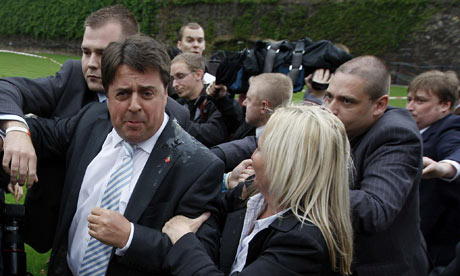
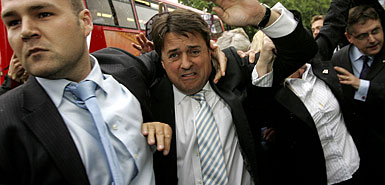


 Oh dear. I think someone needs to tell the Japanese that "UK & Ireland" isn't a language.



 I'm watching Richard Dawkins's pleasingly iconoclastic "The Root Of All Evil?" documentary. In it, he spends some time with
 Mr. Radovan Karadzic might be an



 Continuing his plan to waste as much of my money as possible on his unwanted Olympic Games, Mr. Coe has now blown £400,000 of other peoples' money on this crappy logo. I can't make up my mind whether it looks more like the sort of unreadable graffiti "tags" that cretins spray on trains or whether it looks more like Lisa Simpson giving someone a blow job. Either way, it's money well wasted.
 This logo clearly says that Virgin are going to fuck you up with radioactive Pringles.
 Turquoise and purple